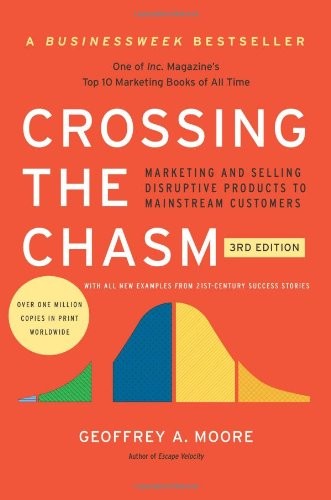
Crossing the Chasm by Geoffrey A. Moore is a 1991 business book about marketing, technology adoption, startups. There is a dangerous gap — the chasm — between Early Adopters (visionaries) and the Early Majority (pragmatists) that stops most technology companies before they reach mainstream markets.
Summary
Crossing the Chasm is Geoffrey Moore's analysis of why so many technology companies succeed with early adopters and then stall before reaching mainstream customers. The technology adoption lifecycle — Innovators, Early Adopters, Early Majority, Late Majority, Laggards — was already a familiar framework when Moore published the first edition in 1991, but he identified something the original model missed: there is a dangerous discontinuity, a "chasm," between Early Adopters and the Early Majority, and falling into it has killed more promising technology companies than bad products or weak execution.
Early Adopters are visionaries. They buy new technology for competitive advantage, tolerate bugs and incompleteness, and don't need the product to fit neatly into an existing category. The Early Majority — the mainstream buyers who represent the bulk of the market — are pragmatists. They want proven solutions, references from similar buyers, complete ecosystems, and reduced risk. The visionary and the pragmatist are so different in their buying psychology that a company's success with one group can actually make the other group more cautious.
Moore's prescription for crossing the chasm is counterintuitive: rather than trying to reach the mainstream market broadly, focus all resources on dominating a single niche. He calls this the bowling pin strategy — pick the head pin, own it completely, then use that beachhead to knock over adjacent markets. The head pin should be a specific target customer with a specific pain that your product solves completely better than any alternative, with enough urgency that they will take a risk on an unproven vendor.
The book holds up well despite its age, especially its core taxonomy of buyer types and its argument that market segments should be defined by which customers can reference each other, not by industry classifications. Some of the specific examples are dated, but the underlying dynamics — the chasm between early adopters and pragmatists, the need for a beachhead strategy — are as relevant to B2B SaaS companies today as they were to workstation vendors in 1991.
Talk to Crossing the Chasm like its author wrote you back.
Get the ideas that fit your life — not generic summaries.
- Chat with the book
- Audiobook-style main ideas
- Adapts to your life and goals
- Helps you take action
Key takeaways
- 1.
There is a dangerous gap — the chasm — between Early Adopters (visionaries) and the Early Majority (pragmatists) that stops most technology companies before they reach mainstream markets.
- 2.
Visionaries and pragmatists buy so differently that success with one group can make the other group more wary, not more confident.
- 3.
To cross the chasm, concentrate all resources on a single beachhead: one specific market segment with a specific problem you can solve completely.
- 4.
The bowling pin strategy: dominate the beachhead, use those references to attack adjacent segments, and expand outward from a position of strength.
- 5.
Pragmatists need complete solutions — product, support, integration, references from similar buyers. They won't buy from you unless you can provide the whole product.
- 6.
Target customers for the beachhead should be identifiable people who can reference each other and who face enough urgency that they will accept a new, unproven vendor.
- 7.
Market segments for technology companies should be defined by which customers will talk to each other, not by traditional industry classification.
- 8.
The biggest mistake is trying to reach the mainstream market broadly rather than dominating a segment first. Broad early launches spread resources too thin to achieve the reference density pragmatists require.
Discussion questions
Use these on your own, with a book club, or as chat starters in Superbook. Book club version, ready to copy or print →
- 1.
Moore's chasm is about the gap between visionaries and pragmatists. Can you think of a technology product you've seen stall at exactly that point? What happened?
- 2.
What makes a good beachhead market? What criteria would you use to choose yours if you were launching a new B2B product today?
- 3.
Moore says pragmatists want references from customers like themselves. How does a company get those first pragmatist references when it hasn't yet sold to pragmatists?
- 4.
The whole product concept — everything a customer needs to succeed, not just the core software — is central to the chasm argument. What components are missing from a whole product you rely on?
- 5.
Has a technology you use personally crossed the chasm? What changed in the product, marketing, or company when it did?
- 6.
Moore distinguishes between market segments based on references, not industries. How would you apply that definition to map segments in a market you know well?
- 7.
Early Adopter sales often require relationship-heavy, custom-deal approaches. How does a company switch from that mode to the more scalable, systematic selling that pragmatists require?
- 8.
The bowling pin strategy requires winning one segment completely before moving to the next. What organizational pressures push companies to expand too early?
- 9.
Does the chasm concept apply to non-technology businesses? Where do you see analogous adoption gaps in other markets?
- 10.
Moore argues the Early Majority is actually the biggest market opportunity. Why do so many companies keep chasing visionaries instead of systematically crossing to pragmatists?
- 11.
What would Crossing the Chasm say about a consumer startup that has viral adoption among college students but struggles to convert to broader audiences?
- 12.
Moore wrote the first edition in 1991. Which aspects of his framework have aged best, and which feel most dated given how software is now bought and sold?
Themes
Frequently asked questions
-
Is Crossing the Chasm still relevant?
Yes. The core insight — that visionaries and pragmatists buy fundamentally differently and that you need a beachhead strategy to bridge them — applies to most B2B technology markets today. The specific examples are dated, but the framework transfers cleanly to SaaS, developer tools, and enterprise software.
-
Who should read Crossing the Chasm?
Founders and product marketers at B2B technology startups, especially those who have found initial traction with early adopters but are struggling to grow beyond a small base of enthusiastic but non-representative customers.
-
What is the chasm, exactly?
The gap between Early Adopters — visionaries who buy for competitive advantage and tolerate unfinished products — and the Early Majority — pragmatists who want proven solutions and complete ecosystems. Most technology companies fail to bridge this gap and stall.
-
How do you pick your beachhead market?
Moore recommends choosing a segment where you can completely solve a specific urgent pain, where buyers know and reference each other, and where winning that segment gives you a defensible platform to expand. Target the smallest segment you can completely dominate, not the largest one you can vaguely address.
-
Does the chasm apply to consumer products?
Somewhat. Consumer adoption curves have similar discontinuities, but the dynamics are different — consumer adoption is driven more by network effects and social proof than by whole product completeness. The framework is most precise for B2B technology markets.
Similar books
The Innovator's Dilemma
Clayton M. Christensen
Blue Ocean Strategy
W. Chan Kim and Renée Mauborgne

Zero to One: Notes on Startups, or How to Build the Future
Peter Thiel
Obviously Awesome
April Dunford
