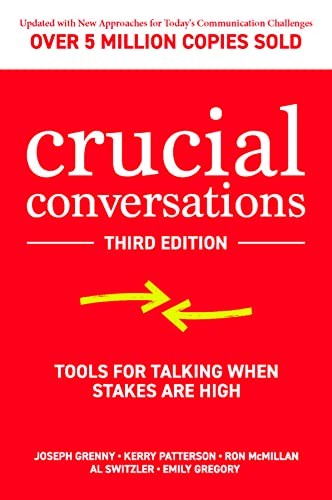
Talk to Crucial Conversations: Tools for Talking When Stakes Are High like its author wrote you back.
Get the ideas that fit your life — not generic summaries.
- Chat with the book
- Audiobook-style main ideas
- Adapts to your life and goals
- Helps you take action
What it argues
Crucial Conversations is a book about what to do when the stakes are high, emotions run strong, and opinions diverge. Patterson, Grenny, McMillan, and Switzler define a crucial conversation not as a fight or a formal negotiation but as any exchange where the outcome matters and one or both parties feel threatened. The authors argue that most people default to one of two failure modes in these moments: they go silent, avoiding the discomfort by withdrawing, hinting, or sugar-coating, or they go violent, pushing their view so hard that the other person shuts down. Neither route solves anything.
The book's central concept is the Pool of Shared Meaning. Dialogue works, the authors argue, when both parties feel safe enough to add information to a shared space rather than hoarding it or attacking with it. Creating that safety is the real skill. This means monitoring two signals: whether the conversation has become safe and whether your own story about what's happening is accurate. People fill in the gaps of other people's behavior with stories, often villainous ones, and those stories drive emotional responses before the other person has said a word. The authors call these "clever stories" and give a method for examining them.
What it gets right
- 1.
Crucial conversations are any exchange where stakes are high, emotions run strong, and opinions diverge. Most people either go silent or become aggressive in these moments, and both responses prevent real dialogue.
- 2.
The Pool of Shared Meaning is the set of facts, feelings, and stories both parties bring. Dialogue works when people feel safe enough to add to it honestly rather than withhold or attack.
- 3.
People fill gaps in others' behavior with stories, often villainous ones. Recognizing you are telling yourself a story — and testing it — is the first step to staying in dialogue.
What it covers
Who wrote it
Kerry Patterson, Joseph Grenny, Ron McMillan, and Al Switzler are organizational consultants and co-founders of VitalSmarts, a corporate training company. They have collectively spent decades studying high-stakes communication in workplaces, relationships, and high-performing teams. Together they also wrote Influencer: The New Science of Leading Change and Crucial Accountability. Crucial Conversations, first published in 2002, has sold more than five million copies and is used in leadership development programs at hundreds of organizations worldwide.
