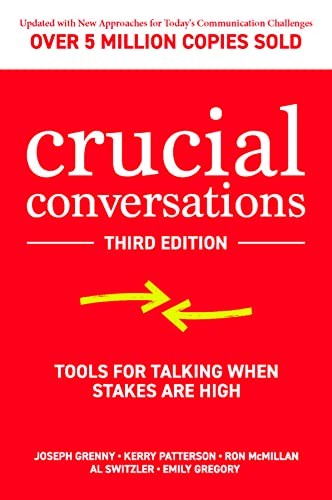
Talk to Crucial Conversations: Tools for Talking When Stakes Are High like its author wrote you back.
Get the ideas that fit your life — not generic summaries.
- Chat with the book
- Audiobook-style main ideas
- Adapts to your life and goals
- Helps you take action
Crucial Conversations: Tools for Talking When Stakes Are High, in detail
Crucial Conversations is a book about what to do when the stakes are high, emotions run strong, and opinions diverge. Patterson, Grenny, McMillan, and Switzler define a crucial conversation not as a fight or a formal negotiation but as any exchange where the outcome matters and one or both parties feel threatened. The authors argue that most people default to one of two failure modes in these moments: they go silent, avoiding the discomfort by withdrawing, hinting, or sugar-coating, or they go violent, pushing their view so hard that the other person shuts down. Neither route solves anything.
The book's central concept is the Pool of Shared Meaning. Dialogue works, the authors argue, when both parties feel safe enough to add information to a shared space rather than hoarding it or attacking with it. Creating that safety is the real skill. This means monitoring two signals: whether the conversation has become safe and whether your own story about what's happening is accurate. People fill in the gaps of other people's behavior with stories, often villainous ones, and those stories drive emotional responses before the other person has said a word. The authors call these "clever stories" and give a method for examining them.
The practical tools come in the second half. STATE is an acronym for sharing your facts, telling your story, asking for the other's path, talking tentatively, and encouraging testing. AMPP covers the listening side: ask, mirror, paraphrase, prime. The authors walk through how to spot when safety has broken down, how to step out of the content of a conversation to repair the relationship, and how to move from dialogue to a decision that actually gets followed through. The decision-making framework is one of the more overlooked parts of the book: it distinguishes between who should consult, who should decide, and who should be informed, and insists that ambiguity here is how most dialogue fails.
Crucial Conversations is well structured and the examples are recognizable. The weakness is repetition: the core insight — that safety enables honesty, and that you control the story you tell yourself — is restated many times across chapters that could be tighter. Readers who want a quick framework will find the book longer than necessary. But for anyone who has avoided a hard conversation, watched a team fall silent in a meeting, or escalated a disagreement they meant to resolve, the tools are concrete enough to start using immediately.
The big ideas
- 1.
Crucial conversations are any exchange where stakes are high, emotions run strong, and opinions diverge. Most people either go silent or become aggressive in these moments, and both responses prevent real dialogue.
- 2.
The Pool of Shared Meaning is the set of facts, feelings, and stories both parties bring. Dialogue works when people feel safe enough to add to it honestly rather than withhold or attack.
- 3.
People fill gaps in others' behavior with stories, often villainous ones. Recognizing you are telling yourself a story — and testing it — is the first step to staying in dialogue.
