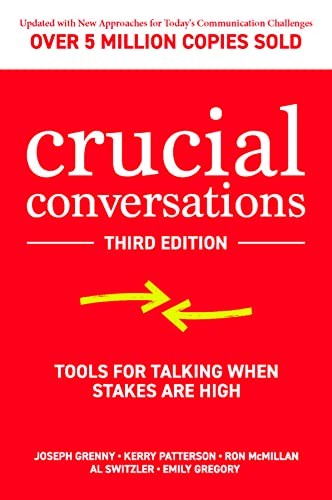
Crucial Conversations: Tools for Talking When Stakes Are High by Kerry Patterson, Joseph Grenny, Ron McMillan, and Al Switzler is a 2002 self-help book about communication, conflict, dialogue. Crucial conversations are any exchange where stakes are high, emotions run strong, and opinions diverge. Most people either go silent or become aggressive in these moments, and both responses prevent real dialogue.
Summary
Crucial Conversations is a book about what to do when the stakes are high, emotions run strong, and opinions diverge. Patterson, Grenny, McMillan, and Switzler define a crucial conversation not as a fight or a formal negotiation but as any exchange where the outcome matters and one or both parties feel threatened. The authors argue that most people default to one of two failure modes in these moments: they go silent, avoiding the discomfort by withdrawing, hinting, or sugar-coating, or they go violent, pushing their view so hard that the other person shuts down. Neither route solves anything.
The book's central concept is the Pool of Shared Meaning. Dialogue works, the authors argue, when both parties feel safe enough to add information to a shared space rather than hoarding it or attacking with it. Creating that safety is the real skill. This means monitoring two signals: whether the conversation has become safe and whether your own story about what's happening is accurate. People fill in the gaps of other people's behavior with stories, often villainous ones, and those stories drive emotional responses before the other person has said a word. The authors call these "clever stories" and give a method for examining them.
The practical tools come in the second half. STATE is an acronym for sharing your facts, telling your story, asking for the other's path, talking tentatively, and encouraging testing. AMPP covers the listening side: ask, mirror, paraphrase, prime. The authors walk through how to spot when safety has broken down, how to step out of the content of a conversation to repair the relationship, and how to move from dialogue to a decision that actually gets followed through. The decision-making framework is one of the more overlooked parts of the book: it distinguishes between who should consult, who should decide, and who should be informed, and insists that ambiguity here is how most dialogue fails.
Crucial Conversations is well structured and the examples are recognizable. The weakness is repetition: the core insight — that safety enables honesty, and that you control the story you tell yourself — is restated many times across chapters that could be tighter. Readers who want a quick framework will find the book longer than necessary. But for anyone who has avoided a hard conversation, watched a team fall silent in a meeting, or escalated a disagreement they meant to resolve, the tools are concrete enough to start using immediately.
Talk to Crucial Conversations: Tools for Talking When Stakes Are High like its author wrote you back.
Get the ideas that fit your life — not generic summaries.
- Chat with the book
- Audiobook-style main ideas
- Adapts to your life and goals
- Helps you take action
Key takeaways
- 1.
Crucial conversations are any exchange where stakes are high, emotions run strong, and opinions diverge. Most people either go silent or become aggressive in these moments, and both responses prevent real dialogue.
- 2.
The Pool of Shared Meaning is the set of facts, feelings, and stories both parties bring. Dialogue works when people feel safe enough to add to it honestly rather than withhold or attack.
- 3.
People fill gaps in others' behavior with stories, often villainous ones. Recognizing you are telling yourself a story — and testing it — is the first step to staying in dialogue.
- 4.
Safety breaks down in two ways: people feel your purpose is wrong (lack of mutual purpose) or that you do not respect them (lack of mutual respect). Restoring either means stepping out of the content and addressing the relationship first.
- 5.
The STATE method — Share your facts, Tell your story, Ask for the other's path, Talk tentatively, Encourage testing — gives a structure for raising hard topics without triggering defensiveness.
- 6.
AMPP — Ask, Mirror, Paraphrase, Prime — is the listening counterpart. It draws out the other person's view when they have gone silent or given only a hint of what they actually think.
- 7.
Dialogue without follow-through fails. Distinguishing who should consult, who should decide, and who should be informed prevents the ambiguity that turns good conversations into unresolved agreements.
- 8.
Silence is not the same as agreement. Teams that look aligned in meetings often have unresolved objections. The authors call this the "sucker's choice" — the false belief that you must choose between telling the truth and keeping the peace.
Discussion questions
Use these on your own, with a book club, or as chat starters in Superbook. Book club version, ready to copy or print →
- 1.
Think of a conversation you have been avoiding for more than two weeks. What story are you telling yourself about why it is not worth having?
- 2.
The book distinguishes going silent from going violent. Which is your default when a conversation feels dangerous?
- 3.
Patterson and colleagues argue that safety, not tact, is what makes honesty possible. What is a relationship in your life where low safety has made you less honest than you should be?
- 4.
Pick a recent argument that escalated. At what point did the conversation leave the content and become about respect or purpose? Could you have named that shift in the moment?
- 5.
The authors describe "clever stories" that cast others as villains and ourselves as victims. What clever story have you told yourself about someone that a more complete view might complicate?
- 6.
STATE asks you to share facts before conclusions. How often do you lead with your interpretation rather than the behavior you actually observed?
- 7.
What would it look like to apply mutual purpose in a situation where you and someone else seem to want genuinely different things?
- 8.
The book argues that how you enter a conversation determines what is possible in it. What do you typically do to prepare for a hard conversation, and is it enough?
- 9.
AMPP includes priming — putting words to what you think someone might be feeling so they can confirm or correct. When has someone done that for you, and what effect did it have?
- 10.
The decision-making framework asks who should consult, who should decide, and who should be informed. Where in your work or home life is that ambiguity causing real friction?
- 11.
What does "going to the balcony" look like for you — is there a physical move, a phrase, or a pause that helps you step back when a conversation is starting to run away from you?
- 12.
What is the most expensive silence you have witnessed in a team or organization? What was the cost of not saying the thing that needed to be said?
Themes
Frequently asked questions
-
Is Crucial Conversations worth reading?
Yes, particularly if you have a specific relationship or workplace dynamic where conversations reliably go wrong. The book is practical rather than theoretical, and most readers can identify the failure patterns immediately. If you already use tools like nonviolent communication or interest-based negotiation, the overlap is significant.
-
How long does it take to read Crucial Conversations?
Around five to five and a half hours at an average pace. The book is 240 pages in most editions. Chapters are short enough to read in a single sitting, which makes it easy to finish in a weekend.
-
What is the main idea of Crucial Conversations?
When the stakes are high and emotions run strong, most people either go silent or get aggressive. Both responses destroy dialogue. The book teaches how to create enough psychological safety that both parties can share what they actually think, then move to a decision.
-
Who should read Crucial Conversations?
Managers navigating performance conversations, couples stuck in the same argument, team leads whose meetings go quiet when things get hard, and anyone who has avoided an important conversation for weeks. The tools apply anywhere the relationship matters and the stakes feel real.
-
What is the Pool of Shared Meaning?
The authors use this term for the shared space of facts, feelings, and stories that becomes available when both people feel safe enough to be honest. The goal of any crucial conversation is to fill that pool rather than let each party work from a private, incomplete view of the situation.
Similar books
Never Split the Difference
Chris Voss
Getting to Yes: Negotiating Agreement Without Giving In
Roger Fisher and William Ury
Influence: The Psychology of Persuasion
Robert B. Cialdini
The 7 Habits of Highly Effective People
Stephen R. Covey
