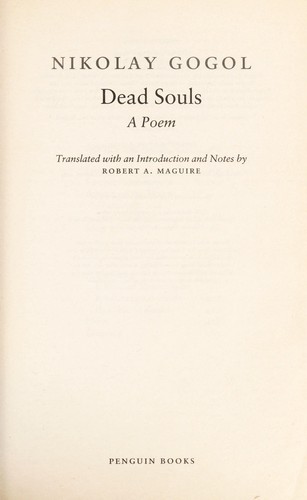
Talk to Dead Souls like its author wrote you back.
Get the ideas that fit your life — not generic summaries.
- Chat with the book
- Audiobook-style main ideas
- Adapts to your life and goals
- Helps you take action
What it argues
Pavel Ivanovich Chichikov arrives in a provincial Russian town with a plan of remarkable ingenuity: he will travel from estate to estate buying up "dead souls" — serfs who have died since the last census but still appear on the tax rolls, and whose owners are still liable for taxes on them. By acquiring legal title to these dead serfs cheaply, he can use them as collateral for a government loan and quietly become rich. The scheme requires visiting a gallery of provincial landowners, each one a specimen of a different variety of human mediocrity and excess.
Dead Souls is a satirical masterpiece disguised as a picaresque road novel. Gogol's gallery of landowners — the sweet, bewildered Manilov; the garrulous Korobochka; the braggart and swindler Nozdryov; the aggressive miser Sobakevich; the extreme hoarder Plyushkin — are archetypes of a certain Russian provincial type, and they remain recognizable two centuries later. The comedy is both broad and precise: Gogol is not just making fun of individuals but rendering a social world in which corruption and stupidity have been so thoroughly normalized that Chichikov's scheme is only slightly more fraudulent than ordinary life.
What it gets right
- 1.
Gogol's gallery of landowners is a taxonomy of spiritual deadness: each one illustrates a different way that greed, laziness, or self-delusion hollows out a human being.
- 2.
Chichikov is almost without inner life — a function more than a character — which makes him the perfect observer-catalyst for a novel whose real subject is everyone around him.
- 3.
The 'dead souls' of the title operate on multiple levels: the deceased serfs, yes, but also the spiritually vacant landowners and, implicitly, a Russia that has lost its way.
What it covers
Who wrote it
Nikolai Gogol (1809–1852) was a Ukrainian-born Russian writer who became one of the most original and influential figures in Russian literature. His early stories, including the collection Evenings on a Farm Near Dikanka, drew on Ukrainian folk tradition; his later work — the story collection Mirgorod, the play The Government Inspector, and Dead Souls — are satirical masterpieces of social observation. Gogol suffered severe religious anxiety in his later years, burned much of his work including the second volume of Dead Souls, and died in 1852 at forty-two. His influence on subsequent Russian literature is immeasurable; Dostoevsky's remark that "we all came out from under Gogol's Overcoat"
