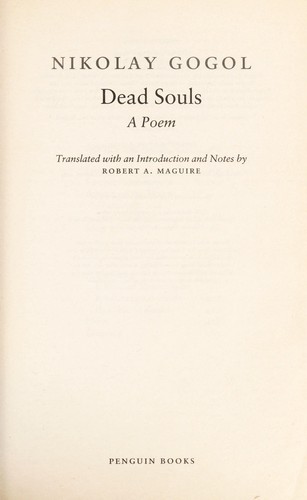
Dead Souls by Nikolai Gogol is a 1842 literary fiction book about corruption and provincial russia, identity and self-deception, satire of bureaucracy. Gogol's gallery of landowners is a taxonomy of spiritual deadness: each one illustrates a different way that greed, laziness, or self-delusion hollows out a human being.
Summary
Pavel Ivanovich Chichikov arrives in a provincial Russian town with a plan of remarkable ingenuity: he will travel from estate to estate buying up "dead souls" — serfs who have died since the last census but still appear on the tax rolls, and whose owners are still liable for taxes on them. By acquiring legal title to these dead serfs cheaply, he can use them as collateral for a government loan and quietly become rich. The scheme requires visiting a gallery of provincial landowners, each one a specimen of a different variety of human mediocrity and excess.
Dead Souls is a satirical masterpiece disguised as a picaresque road novel. Gogol's gallery of landowners — the sweet, bewildered Manilov; the garrulous Korobochka; the braggart and swindler Nozdryov; the aggressive miser Sobakevich; the extreme hoarder Plyushkin — are archetypes of a certain Russian provincial type, and they remain recognizable two centuries later. The comedy is both broad and precise: Gogol is not just making fun of individuals but rendering a social world in which corruption and stupidity have been so thoroughly normalized that Chichikov's scheme is only slightly more fraudulent than ordinary life.
The novel was conceived as the first part of a trilogy Gogol compared to Dante's Divine Comedy — Dead Souls being Hell, with Purgatorio and Paradise to follow. He destroyed the draft of Part Two in a religious crisis before his death, leaving only fragments. The completed Part One works as a self-contained satire, but knowing Gogol's larger intention casts the famous lyrical digression on Russia as a troika — "Where are you galloping, Russia? Give me an answer!" — in a different light. He did not know the answer and may have died knowing he never would.
Gogol's prose is unlike anyone else's: dense with comic digressions, sudden lyric passages, objects described in loving absurd detail, narrators who step in to editorialize and then disappear. The novel rewards readers who enjoy verbal texture and satirical accumulation; it frustrates those who want propulsive plot. Chichikov is deliberately shallow as a protagonist — he is less a character than a device for exposing others. The soul of the book is in the landowners, the town gossips, and the narrator's voice, not in him.
Talk to Dead Souls like its author wrote you back.
Get the ideas that fit your life — not generic summaries.
- Chat with the book
- Audiobook-style main ideas
- Adapts to your life and goals
- Helps you take action
Key takeaways
- 1.
Gogol's gallery of landowners is a taxonomy of spiritual deadness: each one illustrates a different way that greed, laziness, or self-delusion hollows out a human being.
- 2.
Chichikov is almost without inner life — a function more than a character — which makes him the perfect observer-catalyst for a novel whose real subject is everyone around him.
- 3.
The 'dead souls' of the title operate on multiple levels: the deceased serfs, yes, but also the spiritually vacant landowners and, implicitly, a Russia that has lost its way.
- 4.
Gogol's satirical method is not caricature but accumulation: he loads each landowner with so many specific, absurd, recognizable details that they become both comic and terrifying.
- 5.
The lyric passages — particularly the troika apostrophe — are jarring breaks from the satire and represent Gogol's genuine love for Russia alongside his horror at what it had become.
- 6.
Plyushkin, the extreme hoarder whose estate is visibly rotting while he sits on heaps of useless objects, is the novel's darkest portrait and its most psychologically modern one.
- 7.
The scheme Chichikov runs exploits a bureaucratic absurdity — the tax census lag — and Gogol implies that any sufficiently clever person could profit from a system this corrupt.
Discussion questions
Use these on your own, with a book club, or as chat starters in Superbook. Book club version, ready to copy or print →
- 1.
Chichikov is a con man, but Gogol gives him more narrative sympathy than most of his victims. Does the novel want you to like him, and if so, why?
- 2.
Each landowner Chichikov visits is a different variety of mediocrity and corruption. Which one did you find most recognizable — and does the recognition make you laugh or cringe?
- 3.
Gogol described Dead Souls as a 'poem' not a novel. What do you think he meant, and does the text support that claim?
- 4.
The famous troika passage — 'Whither art thou soaring away to, then, Russia?' — is a sudden shift from comedy to elegy. Does it land, or does it feel like Gogol changing registers without warning?
- 5.
Gogol burned the second part of Dead Souls before he died. If the completed novel is Hell, what would Purgatory have looked like? What kind of Russia would have to exist for Gogol to write it?
- 6.
The scheme Chichikov runs — buying dead serfs — is only possible because of serfdom itself. Does the novel make the political point explicitly, or is it left as background radiation?
- 7.
Plyushkin is introduced last and is the novel's most extreme character. Why does Gogol save him for last? What is the structural function of his hoarding?
- 8.
Nozdryov, the compulsive liar and braggart, nearly exposes Chichikov several times but is so unreliable that no one believes him. What is Gogol saying about truth-telling in this society?
- 9.
The townspeople's collective hysteria once rumors start about Chichikov — they can't agree on who he is or what he wants — reads almost like a crowd psychology experiment. What is Gogol satirizing there?
- 10.
Dead Souls is in the satirical-novel tradition that runs through Don Quixote and Candide to modern comic novels. How does it compare to other satirical fiction you've read?
- 11.
Gogol wrote this novel while living abroad, looking at Russia from the outside. Does that exile perspective show in the text? What does distance do to satire?
Themes
Frequently asked questions
-
What are 'dead souls' and why is the title so good?
Dead souls are deceased serfs who still appear on the census — and therefore on their owner's tax rolls. Chichikov buys title to them cheaply. But the title also describes the landowners themselves, and arguably Russia as Gogol saw it. The ambiguity is entirely intentional.
-
Is Dead Souls funny?
Yes, genuinely funny — but in a way that accumulates unease. Gogol's comedy works by loading characters and scenes with absurd specific details until the effect tips from laughter to something more disquieting. Readers who enjoy Dickens' grotesque gallery will recognize the mode.
-
Is Dead Souls complete?
Only the first part is complete. Gogol destroyed his draft of the second part in a religious crisis before his death. Fragments survive but they are not really readable as narrative. What exists is the complete Part One, which works as a self-contained satirical novel.
-
How does Dead Souls compare to other Russian novels?
It is less psychologically intense than Dostoevsky and less panoramic than Tolstoy, but it is the most purely comic of the major Russian novels and its satirical vision is sharper than either. It is closer in spirit to the picaresque European tradition than to what came after it in Russia.
-
Who shouldn't read Dead Souls?
Readers who need forward-moving plot or a protagonist they can invest in emotionally. Chichikov is deliberately hollow, and the novel's pleasures are about verbal texture, satirical observation, and the comedy of provincial absurdity rather than narrative tension.