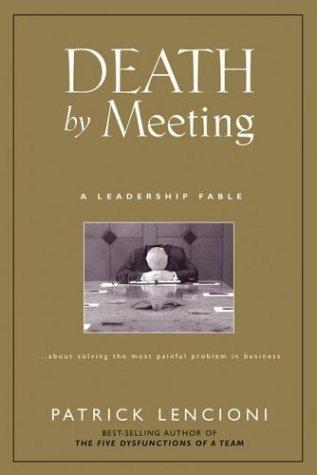
Talk to Death by Meeting like its author wrote you back.
Get the ideas that fit your life — not generic summaries.
- Chat with the book
- Audiobook-style main ideas
- Adapts to your life and goals
- Helps you take action
What it argues
Death by Meeting is Patrick Lencioni's diagnosis of one of the most universal corporate dysfunctions: meetings that are simultaneously painful and pointless. The book is structured in Lencioni's characteristic fable format — a narrative about a company whose meetings are destroying it, followed by a model section that extracts the principles from the story. The protagonist's company is failing not because of strategy or competition but because its meetings are boring, unfocused, and disconnected from the decisions that actually matter.
Lencioni's core argument is that most organizations have the wrong meeting architecture. They combine topics that require different levels of depth and decision-making into a single weekly staff meeting that serves no purpose well. The solution he proposes is a four-meeting model: the Daily Check-in (five minutes of standing, operational updates), the Weekly Tactical (forty-five to ninety minutes on immediate issues and metrics), the Monthly Strategic (two to four hours on one or two critical topics), and the Quarterly Off-site Review (one to two days reviewing strategy, competitive landscape, and organizational health).
What it gets right
- 1.
Most meetings are bad not because of poor facilitation but because of wrong architecture — mixing topics with incompatible depths into a single weekly meeting that serves none of them well.
- 2.
The four-meeting model — Daily Check-in, Weekly Tactical, Monthly Strategic, Quarterly Off-site — segregates topics by time horizon and decision type.
- 3.
Boring meetings are caused by too little conflict, not too much. Leaders who suppress debate produce passive, disengaged attendees and unresolved decisions.
What it covers
Who wrote it
Patrick Lencioni is an American author, speaker, and management consultant who founded The Table Group, a firm focused on organizational health and leadership development. His books include The Five Dysfunctions of a Team, The Advantage, The Ideal Team Player, and The Motive. Lencioni's signature format combines a business fable with a brief model section that extracts the principles from the narrative. His work has been widely adopted in corporate, nonprofit, and church leadership contexts. He has worked with hundreds of organizations and spoken to audiences globally on the topics of teamwork, organizational health, and leadership.
