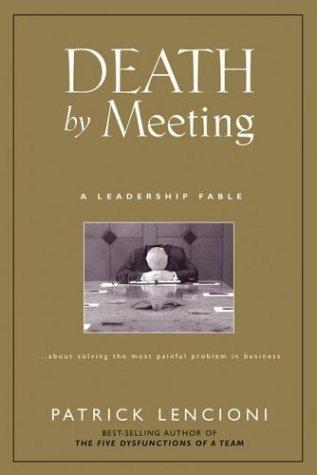
Death by Meeting by Patrick Lencioni is a 2004 business book about meetings, organizational effectiveness, leadership. Most meetings are bad not because of poor facilitation but because of wrong architecture — mixing topics with incompatible depths into a single weekly meeting that serves none of them well.
Summary
Death by Meeting is Patrick Lencioni's diagnosis of one of the most universal corporate dysfunctions: meetings that are simultaneously painful and pointless. The book is structured in Lencioni's characteristic fable format — a narrative about a company whose meetings are destroying it, followed by a model section that extracts the principles from the story. The protagonist's company is failing not because of strategy or competition but because its meetings are boring, unfocused, and disconnected from the decisions that actually matter.
Lencioni's core argument is that most organizations have the wrong meeting architecture. They combine topics that require different levels of depth and decision-making into a single weekly staff meeting that serves no purpose well. The solution he proposes is a four-meeting model: the Daily Check-in (five minutes of standing, operational updates), the Weekly Tactical (forty-five to ninety minutes on immediate issues and metrics), the Monthly Strategic (two to four hours on one or two critical topics), and the Quarterly Off-site Review (one to two days reviewing strategy, competitive landscape, and organizational health).
The second major argument is about conflict. Lencioni claims that boring meetings are not caused by too much conflict but by too little. When leaders suppress debate and push for false consensus, meetings become passive information transfers rather than decision-making forums. The executive who runs a meeting where everyone agrees quickly has not achieved efficiency — they've achieved evasion. Good meetings require mining for conflict, raising uncomfortable topics, and staying with disagreement long enough to reach genuine resolution.
The fable format makes the book fast to read but means the model itself is compressed into fewer than fifty pages. Readers who want more depth on implementation will find the book ends before answering some of their questions. But as a diagnostic framework for what makes meetings bad and what architecture would make them better, the model is clear, memorable, and immediately applicable to most organizational contexts.
Talk to Death by Meeting like its author wrote you back.
Get the ideas that fit your life — not generic summaries.
- Chat with the book
- Audiobook-style main ideas
- Adapts to your life and goals
- Helps you take action
Key takeaways
- 1.
Most meetings are bad not because of poor facilitation but because of wrong architecture — mixing topics with incompatible depths into a single weekly meeting that serves none of them well.
- 2.
The four-meeting model — Daily Check-in, Weekly Tactical, Monthly Strategic, Quarterly Off-site — segregates topics by time horizon and decision type.
- 3.
Boring meetings are caused by too little conflict, not too much. Leaders who suppress debate produce passive, disengaged attendees and unresolved decisions.
- 4.
The Weekly Tactical should focus on near-term obstacles and metrics, not status updates. Status updates belong in the Daily Check-in or email.
- 5.
Monthly Strategic meetings should address one or two genuinely important topics in depth rather than skimming many topics shallowly.
- 6.
Mining for conflict — deliberately surfacing disagreements and competing views — is the executive's job in a meeting, not an unfortunate byproduct.
- 7.
The cost of bad meetings is not just time. It's decision quality, organizational alignment, and the cumulative morale cost of hours spent on theater rather than work.
Discussion questions
Use these on your own, with a book club, or as chat starters in Superbook. Book club version, ready to copy or print →
- 1.
Lencioni argues that most bad meetings are caused by wrong architecture rather than bad facilitation. Does that match your experience of what makes meetings fail?
- 2.
Which of the four meeting types is most missing from your current organizational practice — the Daily Check-in, the Monthly Strategic, or the Quarterly Off-site?
- 3.
He claims boring meetings have too little conflict. Think of a recent meeting that felt passive. What conflict was being avoided?
- 4.
What would need to change in your organization's culture for leaders to actively mine for conflict rather than manage it away?
- 5.
The Weekly Tactical is supposed to address obstacles, not status updates. How much of your weekly meetings is status updates disguised as decisions?
- 6.
Lencioni's model requires meeting more often, not less — the Daily Check-in adds a meeting most organizations don't have. What's the reaction that proposal gets in your organization?
- 7.
The fable format makes the ideas accessible but also somewhat simplified. What real organizational complexity does the four-meeting model not address?
- 8.
How would your most effective executive or manager score against Lencioni's criteria for running meetings? What would they do differently?
- 9.
Lencioni says the Quarterly Off-site should review strategy and organizational health, not just celebrate wins. How different is that from how off-sites actually get used where you work?
- 10.
What is the real cost of bad meetings in your organization — not in time, but in decisions not made, tensions not addressed, and alignment not achieved?
- 11.
If you redesigned your organization's entire meeting cadence from scratch using Lencioni's model, what would you eliminate, and what new meeting would you add?
Themes
Frequently asked questions
-
Is Death by Meeting worth reading?
Yes, if your organization's meetings are consistently painful, unproductive, or both. The four-meeting model is simple enough to implement quickly and addresses the structural causes of most meeting dysfunction. The fable format makes it an easy read. Readers looking for a comprehensive management text should look elsewhere — this is a focused intervention on a single problem.
-
How long does it take to read Death by Meeting?
About three to four hours. The fable takes up roughly two-thirds of the book; the model section is concise. Most people read it in a single sitting or two. The model section rewards re-reading once you've decided to change your meeting structure.
-
What is the four-meeting model?
A meeting architecture with four distinct formats: a five-minute Daily Check-in for operational coordination, a Weekly Tactical for near-term issues, a Monthly Strategic for important decisions that need depth, and a Quarterly Off-site for strategy and organizational review. Each type has a different duration, agenda structure, and purpose.
-
Who should read Death by Meeting?
Leaders and managers who want to fix their organization's meeting culture, particularly those whose teams are suffering from meeting fatigue. Also useful for anyone designing a new team's operating rhythm — the four-meeting model is easier to implement from scratch than to retrofit onto existing dysfunction.
-
Does the fable format work for a business book?
Lencioni uses it across all his books and it divides readers. The fable makes the diagnosis vivid and emotionally engaging, and the characters make the principles memorable. The tradeoff is that the model section is compressed and sometimes leaves implementation questions unanswered. If you find the fable format annoying, skip to the model at the back.