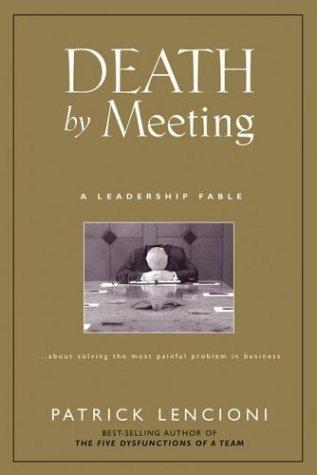
Talk to Death by Meeting like its author wrote you back.
Get the ideas that fit your life — not generic summaries.
- Chat with the book
- Audiobook-style main ideas
- Adapts to your life and goals
- Helps you take action
Death by Meeting, in detail
Death by Meeting is Patrick Lencioni's diagnosis of one of the most universal corporate dysfunctions: meetings that are simultaneously painful and pointless. The book is structured in Lencioni's characteristic fable format — a narrative about a company whose meetings are destroying it, followed by a model section that extracts the principles from the story. The protagonist's company is failing not because of strategy or competition but because its meetings are boring, unfocused, and disconnected from the decisions that actually matter.
Lencioni's core argument is that most organizations have the wrong meeting architecture. They combine topics that require different levels of depth and decision-making into a single weekly staff meeting that serves no purpose well. The solution he proposes is a four-meeting model: the Daily Check-in (five minutes of standing, operational updates), the Weekly Tactical (forty-five to ninety minutes on immediate issues and metrics), the Monthly Strategic (two to four hours on one or two critical topics), and the Quarterly Off-site Review (one to two days reviewing strategy, competitive landscape, and organizational health).
The second major argument is about conflict. Lencioni claims that boring meetings are not caused by too much conflict but by too little. When leaders suppress debate and push for false consensus, meetings become passive information transfers rather than decision-making forums. The executive who runs a meeting where everyone agrees quickly has not achieved efficiency — they've achieved evasion. Good meetings require mining for conflict, raising uncomfortable topics, and staying with disagreement long enough to reach genuine resolution.
The fable format makes the book fast to read but means the model itself is compressed into fewer than fifty pages. Readers who want more depth on implementation will find the book ends before answering some of their questions. But as a diagnostic framework for what makes meetings bad and what architecture would make them better, the model is clear, memorable, and immediately applicable to most organizational contexts.
The big ideas
- 1.
Most meetings are bad not because of poor facilitation but because of wrong architecture — mixing topics with incompatible depths into a single weekly meeting that serves none of them well.
- 2.
The four-meeting model — Daily Check-in, Weekly Tactical, Monthly Strategic, Quarterly Off-site — segregates topics by time horizon and decision type.
- 3.
Boring meetings are caused by too little conflict, not too much. Leaders who suppress debate produce passive, disengaged attendees and unresolved decisions.
