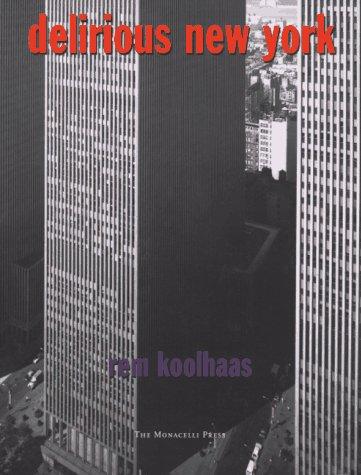
Talk to Delirious New York like its author wrote you back.
Get the ideas that fit your life — not generic summaries.
- Chat with the book
- Audiobook-style main ideas
- Adapts to your life and goals
- Helps you take action
What it argues
Rem Koolhaas published Delirious New York in 1978 with the subtitle "a retroactive manifesto for Manhattan," and that framing is essential to understanding what the book is and isn't. It is not a history of New York architecture in any conventional sense. It is an argument about what Manhattan produced without intending to — an urbanism of extreme density, programmatic congestion, and radical indifference to consistency — and a claim that this condition, which polite architectural culture tended to regard with embarrassment, was actually more interesting and more generative than anything the modernist mainstream was consciously producing.
The book's core concept is "Manhattanism" — the implicit ideology that guided the island's development from the Commissioners' Plan of 1811 through the skyscraper era. Koolhaas argues that Manhattan's grid imposed a rational spatial framework while leaving every block free to contain whatever it could sustain economically and imaginatively. The result was an architecture of radical coexistence: a single city block might contain a boxing gym, a supper club, a hotel with a rooftop track, and a Turkish bath, each stacked above the other on different floors. He calls this "the culture of congestion."
What it gets right
- 1.
Manhattan developed an implicit urban ideology — Manhattanism — that treated extreme density not as a problem to be managed but as an opportunity to generate new forms of metropolitan experience.
- 2.
The grid of 1811 created a neutral framework that left every block free to contain any program. This produced an urbanism of coexistence rather than zoning's urbanism of separation.
- 3.
The skyscraper made it possible to stack unrelated programs vertically, creating a new kind of building that was less architecture than a miniature city operating in a single envelope.
What it covers
Who wrote it
Rem Koolhaas is a Dutch architect, urbanist, and writer, and a founding partner of the Office for Metropolitan Architecture (OMA) and its research arm AMO. He studied journalism before training as an architect at the Architectural Association in London. Delirious New York was his first book and established the theoretical framework for much of his subsequent practice. OMA's major projects include the Seattle Central Library, the CCTV headquarters in Beijing, and the Casa da Música in Porto. He was awarded the Pritzker Architecture Prize in 2000. He continues to teach and write alongside his practice.
