Talk to Delirious New York like its author wrote you back.
Get the ideas that fit your life — not generic summaries.
- Chat with the book
- Audiobook-style main ideas
- Adapts to your life and goals
- Helps you take action
Delirious New York, in detail
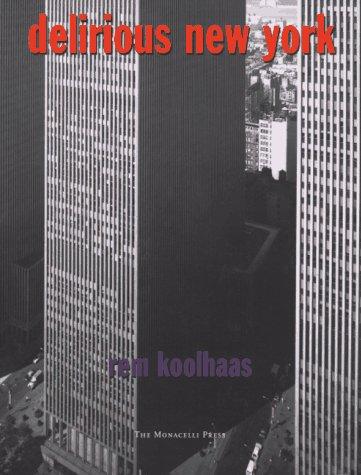
Rem Koolhaas published Delirious New York in 1978 with the subtitle "a retroactive manifesto for Manhattan," and that framing is essential to understanding what the book is and isn't. It is not a history of New York architecture in any conventional sense. It is an argument about what Manhattan produced without intending to — an urbanism of extreme density, programmatic congestion, and radical indifference to consistency — and a claim that this condition, which polite architectural culture tended to regard with embarrassment, was actually more interesting and more generative than anything the modernist mainstream was consciously producing.
The book's core concept is "Manhattanism" — the implicit ideology that guided the island's development from the Commissioners' Plan of 1811 through the skyscraper era. Koolhaas argues that Manhattan's grid imposed a rational spatial framework while leaving every block free to contain whatever it could sustain economically and imaginatively. The result was an architecture of radical coexistence: a single city block might contain a boxing gym, a supper club, a hotel with a rooftop track, and a Turkish bath, each stacked above the other on different floors. He calls this "the culture of congestion."
Some of the book's most striking passages are readings of specific buildings. The Waldorf-Astoria and the Rockefeller Center are analyzed not as architectural masterpieces in the conventional sense but as machines for generating urban experience at scale. The Downtown Athletic Club gets a sustained reading that treats its stacked floors of unlikely programs — boxing on one floor, golf on another, Turkish baths below — as a kind of unconscious surrealism. Koolhaas was writing his dissertation when he produced much of this material, and the intellectual energy of someone discovering ideas for the first time is present throughout.
What makes Delirious New York difficult to categorize is that it mixes genuine scholarship, architectural criticism, speculation, and architectural fiction (the epilogue presents imaginary projects by Salvador Dali and Le Corbusier). Koolhaas is not neutral. He wants to rescue Manhattan's architectural culture from the condescension of European modernism, and he wants to use Manhattan as a source of ideas for his own future practice. The book launched his career and shaped how a generation of architects thought about density and program. Its arguments are most clearly legible in the projects his firm OMA went on to build. Reading Delirious New York as both text and manifesto — recognizing the argument within the apparent history — is the most honest way to engage with it.
The big ideas
- 1.
Manhattan developed an implicit urban ideology — Manhattanism — that treated extreme density not as a problem to be managed but as an opportunity to generate new forms of metropolitan experience.
- 2.
The grid of 1811 created a neutral framework that left every block free to contain any program. This produced an urbanism of coexistence rather than zoning's urbanism of separation.
- 3.
The skyscraper made it possible to stack unrelated programs vertically, creating a new kind of building that was less architecture than a miniature city operating in a single envelope.
