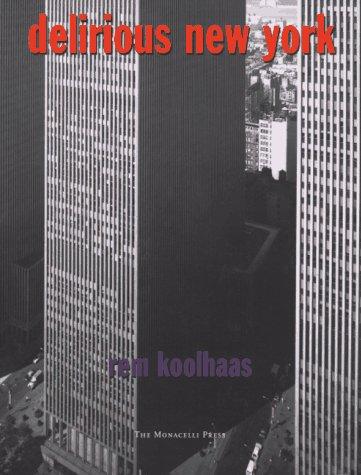
Delirious New York by Rem Koolhaas is a 1978 history book about urbanism, architecture, metropolitan culture. Manhattan developed an implicit urban ideology — Manhattanism — that treated extreme density not as a problem to be managed but as an opportunity to generate new forms of metropolitan experience.
Summary
Rem Koolhaas published Delirious New York in 1978 with the subtitle "a retroactive manifesto for Manhattan," and that framing is essential to understanding what the book is and isn't. It is not a history of New York architecture in any conventional sense. It is an argument about what Manhattan produced without intending to — an urbanism of extreme density, programmatic congestion, and radical indifference to consistency — and a claim that this condition, which polite architectural culture tended to regard with embarrassment, was actually more interesting and more generative than anything the modernist mainstream was consciously producing.
The book's core concept is "Manhattanism" — the implicit ideology that guided the island's development from the Commissioners' Plan of 1811 through the skyscraper era. Koolhaas argues that Manhattan's grid imposed a rational spatial framework while leaving every block free to contain whatever it could sustain economically and imaginatively. The result was an architecture of radical coexistence: a single city block might contain a boxing gym, a supper club, a hotel with a rooftop track, and a Turkish bath, each stacked above the other on different floors. He calls this "the culture of congestion."
Some of the book's most striking passages are readings of specific buildings. The Waldorf-Astoria and the Rockefeller Center are analyzed not as architectural masterpieces in the conventional sense but as machines for generating urban experience at scale. The Downtown Athletic Club gets a sustained reading that treats its stacked floors of unlikely programs — boxing on one floor, golf on another, Turkish baths below — as a kind of unconscious surrealism. Koolhaas was writing his dissertation when he produced much of this material, and the intellectual energy of someone discovering ideas for the first time is present throughout.
What makes Delirious New York difficult to categorize is that it mixes genuine scholarship, architectural criticism, speculation, and architectural fiction (the epilogue presents imaginary projects by Salvador Dali and Le Corbusier). Koolhaas is not neutral. He wants to rescue Manhattan's architectural culture from the condescension of European modernism, and he wants to use Manhattan as a source of ideas for his own future practice. The book launched his career and shaped how a generation of architects thought about density and program. Its arguments are most clearly legible in the projects his firm OMA went on to build. Reading Delirious New York as both text and manifesto — recognizing the argument within the apparent history — is the most honest way to engage with it.
Talk to Delirious New York like its author wrote you back.
Get the ideas that fit your life — not generic summaries.
- Chat with the book
- Audiobook-style main ideas
- Adapts to your life and goals
- Helps you take action
Key takeaways
- 1.
Manhattan developed an implicit urban ideology — Manhattanism — that treated extreme density not as a problem to be managed but as an opportunity to generate new forms of metropolitan experience.
- 2.
The grid of 1811 created a neutral framework that left every block free to contain any program. This produced an urbanism of coexistence rather than zoning's urbanism of separation.
- 3.
The skyscraper made it possible to stack unrelated programs vertically, creating a new kind of building that was less architecture than a miniature city operating in a single envelope.
- 4.
The culture of congestion is Koolhaas's term for the condition that makes Manhattan's energy possible: enough density that different uses, people, and experiences constantly collide.
- 5.
Koolhaas uses the term 'retroactive manifesto' deliberately. He is finding the coherent ideology in what was built unconsciously, then claiming it as a starting point for future architecture.
- 6.
The Downtown Athletic Club is his canonical example: a building where golf, boxing, Turkish baths, and dining are stacked on different floors, each floor a complete world, the totality a kind of urban dream logic.
- 7.
European modernism's critique of American cities — that they were chaotic, commercial, tasteless — missed the point. The chaos was the product, not the problem.
Discussion questions
Use these on your own, with a book club, or as chat starters in Superbook. Book club version, ready to copy or print →
- 1.
Koolhaas calls this a 'retroactive manifesto.' What does it mean for an argument to be retroactive rather than prospective, and does it change how you evaluate its claims?
- 2.
The book argues that Manhattan's density and congestion are generative rather than problems. Does that argument hold equally well for contemporary cities, or does it depend on conditions specific to early twentieth-century New York?
- 3.
Koolhaas treats programmatic mixing — stacking unrelated uses in the same building — as architecturally interesting. What contemporary buildings or places have you experienced that work this way?
- 4.
The book mixes scholarship, criticism, and fiction. Does that combination make the argument more or less convincing to you?
- 5.
He argues that modernism's push for clarity, separation, and rationality actually impoverished urban experience. Do you agree? Can you think of cities or neighborhoods that demonstrate either side of this argument?
- 6.
The 1811 Commissioners' Plan gets a lot of credit for enabling Manhattan's development. What do contemporary city planning decisions look like from the vantage point of a hundred years later?
- 7.
Koolhaas is clearly making an argument for his own architectural practice, not just describing history. Does knowing that change how you read his analysis of specific buildings?
- 8.
The Downtown Athletic Club reading is one of the book's most cited passages. What makes it persuasive, and where does the argument strain?
- 9.
Delirious New York helped make density intellectually respectable in architectural circles. What were the downstream effects of that, in cities you know?
- 10.
What is missing from Koolhaas's account of Manhattan? What experiences or populations does his frame leave out?
- 11.
The book was written in 1978. Which of its arguments have aged well, and which have aged less well in light of how New York and other cities have developed since?
Themes
Frequently asked questions
-
Is Delirious New York difficult to read?
It requires patience. Koolhaas writes densely and mixes close building analysis with large theoretical claims. Readers without some background in architectural history may find the references unfamiliar. But the core argument is accessible and the prose is often striking, especially in the building readings.
-
What is the main argument of Delirious New York?
That Manhattan developed a coherent urban ideology — the culture of congestion — by accident, and that this ideology is more interesting and generative than what European architectural modernism was consciously producing. Koolhaas calls this Manhattanism and proposes it as a model for thinking about dense cities.
-
Who should read Delirious New York?
Architects, urban designers, urban historians, and anyone seriously interested in how cities work. Also worth reading for anyone who has spent time in New York and wants a frame for why the city feels the way it does. Less useful as a practical guide to anything — it's a manifesto, not a handbook.
-
What is OMA?
The Office for Metropolitan Architecture, the architecture and design firm Koolhaas founded in 1975 with Elia and Zoe Zenghelis and Madelon Vriesendorp. Delirious New York was published three years after OMA's founding and articulated the intellectual framework the firm would develop over the following decades.
-
Does Delirious New York hold up as architecture history?
As strict history, it has gaps and omissions that historians have noted. As a work of architectural theory and criticism, it holds up very well. Its analytical frameworks — deep modules, programmatic stacking, the relationship between grid and tower — are still used in architectural education and practice.