Literary fiction · Book club
Demon Copperhead book club questions
Here are 12 book club questions for Demon Copperhead by Barbara Kingsolver, ordered to open easily and end somewhere worth arguing about. Copy them, print them, or bring them up one at a time.
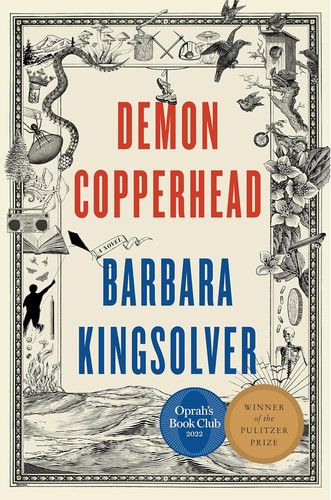
Demon Copperhead is Barbara Kingsolver's retelling of David Copperfield, transposed from Victorian England to the opioid-ravaged mountains of southwest Virginia.
Barbara Kingsolver · 2022 · 12h 0m
Full summary and key takeaways →The 12 questions
- 1.
Kingsolver said in interviews she wanted to write Dickens's story in an American setting where it was still happening. Does the Dickens framework illuminate the opioid crisis, or does it sometimes feel like a constraint?
- 2.
Demon is a highly self-aware narrator who knows he's telling his own story. How does that meta-awareness affect your trust in him?
- 3.
The novel argues the opioid epidemic was inflicted on Appalachia rather than chosen by it. Do you find that argument convincing? Where does it feel strongest and where does it feel most strained?
- 4.
How does Kingsolver handle the line between capturing a regional voice authentically and potentially exoticizing it for a mainstream literary audience?
- 5.
Several characters in the book are helpers who can only do so much against structural conditions. Which of those helpers felt most real to you, and what limited them?
- 6.
Demon's mother is both a victim and someone who fails him. How does the book ask you to hold those two things at once?
- 7.
The foster care sections are some of the book's most brutal. Did the novel change how you think about the system?
- 8.
Compared to educated, another book about growing up poor in rural America — where does Demon Copperhead land harder, and why?
- 9.
Football is the novel's central irony. Does Kingsolver complicate it enough, or does it feel like a device?
- 10.
The book is very long. What would you have cut, if anything? What would you have lost?
- 11.
Who in the novel gets to escape, and who doesn't? What determines the difference?
- 12.
How does the ending sit with you? Did Demon earn it, or did you want more?
How to run the discussion
- Pick six to eight, not all of them. An hour of real discussion covers fewer questions than anyone expects, and racing the list is what makes a book club feel like homework.
- Open with what people noticed, not what they concluded. Asking for a verdict first hardens opinions before anyone has heard each other.
- Let the disagreement run. The questions below that split a room are the ones worth the time; the ones everyone answers the same way can be skipped.
- Ask the quiet person a specific question. A direct, narrow question is far easier to answer than an open invitation to contribute.
Themes worth steering toward
If the conversation stalls, these are the threads that usually restart it.
Common questions
What are good book club questions for Demon Copperhead?
Here are 12 book club questions for Demon Copperhead by Barbara Kingsolver, ordered to open easily and end somewhere worth arguing about. The strongest openers ask what each reader noticed rather than what they concluded, and the discussion usually turns on poverty and class, addiction, childhood survival.
How long should a book club discussion of Demon Copperhead last?
Most groups run 60 to 90 minutes of actual discussion. That is roughly six to eight questions, not all of them, so pick the ones that suit your group rather than working down the list in order.
What are the main themes in Demon Copperhead?
Poverty and class, Addiction, Childhood survival, Foster care and neglect, Appalachian identity. Those are the threads most likely to divide a room, which makes them the useful places to steer a discussion that has gone quiet.
Picking the next one? See books like Demon Copperhead or questions for other book club picks.
