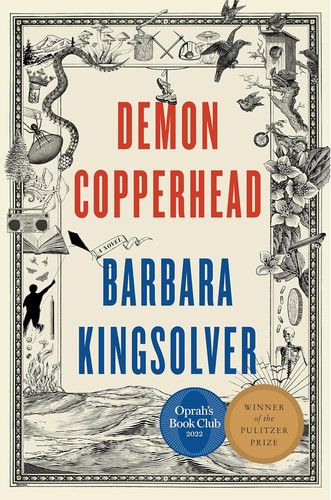
Talk to Demon Copperhead like its author wrote you back.
Get the ideas that fit your life — not generic summaries.
- Chat with the book
- Audiobook-style main ideas
- Adapts to your life and goals
- Helps you take action
Demon Copperhead, in detail
Demon Copperhead is Barbara Kingsolver's retelling of David Copperfield, transposed from Victorian England to the opioid-ravaged mountains of southwest Virginia. The narrator, born Damon Fields but known as Demon, tells his own story from birth in a single-wide trailer to a series of calamities that track almost beat for beat with Dickens — a beloved mother, a monstrous stepfather, the foster care system, child labor, and a cast of helpers and exploiters who each take a turn shaping him. Kingsolver won the Pulitzer Prize for this novel in 2023, and it earned it.
What the book is actually about is the opioid epidemic as a systemic failure rather than a personal moral failing. Demon ends up addicted to painkillers after a football injury — a pattern that played out across the region in the late 1990s and 2000s as pharmaceutical companies flooded rural communities with OxyContin. Kingsolver is making an argument: the same forces that exploited Appalachia for coal and timber exploited it again with synthetic opioids, and the casualties were largely invisible to the rest of the country because the people involved were poor and Southern. The Dickens parallel isn't decoration; it's the point. Working-class children failed by every institution that should protect them is not a new story.
The formal achievement is Demon's voice. He narrates in a vernacular that's funny, sharp, self-aware, and never condescending. Kingsolver spent years researching the region and its dialect, and it shows — the voice feels earned rather than performed. The novel is also structurally faithful to Dickens in ways that reward readers who know the original: the Agnes figure, the Micawber figure, the Uriah Heep figure all appear in updated forms, and part of the pleasure is watching Kingsolver adapt Victorian plot machinery to twenty-first-century American conditions.
At 550 pages the book asks a real time commitment, and the middle section, where Demon's addiction deepens, is genuinely difficult to read. Readers who want to keep a safe distance from the subject won't find one here. But readers who can sit with the discomfort will find one of the most fully inhabited American voices in recent fiction — a narrator you believe completely, in a story that's angry on behalf of people who deserved better.
The big ideas
- 1.
The opioid epidemic in rural America was not a moral failure of individuals but a deliberate exploitation of economically vulnerable communities, enabled by pharmaceutical companies and policy indifference.
- 2.
Demon's voice is the novel's great achievement — vernacular, funny, and precise without ever feeling like a performance of rural poverty.
- 3.
The Dickens parallel works because the Victorian conditions Dickens exposed — child labor, institutional neglect, class exploitation — never actually went away; they just moved.
