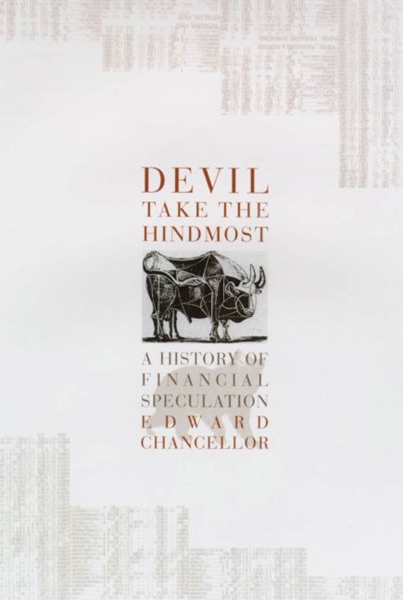
Talk to Devil Take the Hindmost: A History of Financial Speculation like its author wrote you back.
Get the ideas that fit your life — not generic summaries.
- Chat with the book
- Audiobook-style main ideas
- Adapts to your life and goals
- Helps you take action
What it argues
Edward Chancellor's 1999 history of financial speculation begins with seventeenth-century Holland and ends with the Japanese bubble of the 1980s and early signs of the dot-com excess that would peak after the book's publication. The argument threading through four centuries of tulip manias, South Sea bubbles, railroad frenzies, and stock market crashes is that the speculative impulse is not an aberration from capitalism but a recurring feature of it — that the same patterns emerge again and again, driven by the same combination of easy credit, novel instruments, a compelling narrative, and the human tendency to believe that this time is different.
Chancellor draws on primary sources and contemporary accounts to make each episode vivid rather than schematic. The South Sea Bubble chapter is rich with the specifics of how shares were inflated — the company's directors selling while the public was buying, the parliamentary corruption that kept the scheme alive, the social catastrophe when it collapsed. The nineteenth-century railroad manias, which occurred simultaneously in Britain, France, and America, show how genuine productive investment can coexist with speculative fever that destroys most of the investors who participate. The late nineteenth-century United States, with its gilded age of railroad and stock manipulation, produces some of the book's most vivid characters.
What it gets right
- 1.
Financial bubbles follow a recognizable pattern: a novel asset or technology, a compelling narrative, easy credit, and the gradual recruitment of the general public into speculation that professionals have already exited.
- 2.
The speculative impulse is not separate from capitalism but intrinsic to it. Periods of genuine productive investment are regularly accompanied by speculative fever that destroys wealth on a large scale.
- 3.
Easy credit is the enabling condition of most major speculative manias. When borrowing is cheap and assets are rising, leverage amplifies gains on the way up and losses on the way down.
What it covers
Who wrote it
Edward Chancellor is a British financial historian and journalist. He studied at Cambridge and Oxford and worked at Lazard Brothers before becoming a writer on financial history and markets. Devil Take the Hindmost was his first book and became a standard reference in discussions of financial bubbles. He has written about financial markets for the Financial Times, the Wall Street Journal, and Institutional Investor, and has worked as a strategist for asset managers. His work is notable for combining archival historical research with direct relevance to contemporary market conditions.
