Devil Take the Hindmost: A History of Financial Speculation by Edward Chancellor is a 1999 history book about financial speculation, market bubbles, financial history. Financial bubbles follow a recognizable pattern: a novel asset or technology, a compelling narrative, easy credit, and the gradual recruitment of the general public into speculation that professionals have already exited.
Summary
Edward Chancellor's 1999 history of financial speculation begins with seventeenth-century Holland and ends with the Japanese bubble of the 1980s and early signs of the dot-com excess that would peak after the book's publication. The argument threading through four centuries of tulip manias, South Sea bubbles, railroad frenzies, and stock market crashes is that the speculative impulse is not an aberration from capitalism but a recurring feature of it — that the same patterns emerge again and again, driven by the same combination of easy credit, novel instruments, a compelling narrative, and the human tendency to believe that this time is different.
Chancellor draws on primary sources and contemporary accounts to make each episode vivid rather than schematic. The South Sea Bubble chapter is rich with the specifics of how shares were inflated — the company's directors selling while the public was buying, the parliamentary corruption that kept the scheme alive, the social catastrophe when it collapsed. The nineteenth-century railroad manias, which occurred simultaneously in Britain, France, and America, show how genuine productive investment can coexist with speculative fever that destroys most of the investors who participate. The late nineteenth-century United States, with its gilded age of railroad and stock manipulation, produces some of the book's most vivid characters.
The later chapters cover the 1920s boom and 1929 crash, the Japanese economic miracle and its collapse into the lost decade, and the early stages of the 1990s internet speculation. Chancellor is consistently interested in the regulatory and political environment that allows each bubble to inflate — in how financial innovation outruns oversight, and in how the people who should provide corrective warnings are typically silenced by their financial interests in continuation.
The book was published in 1999, a year before the dot-com collapse. Chancellor's analysis of the period reads as a warning that was well-timed but couldn't stop what was coming. The historical perspective he provides is more useful now than at publication: the patterns he describes in seventeenth-century tulip speculation map directly onto cryptocurrency manias, tech stock bubbles, and housing price run-ups of the twenty-first century. The book's implicit argument is that understanding financial history is a partial inoculation against repeating it.
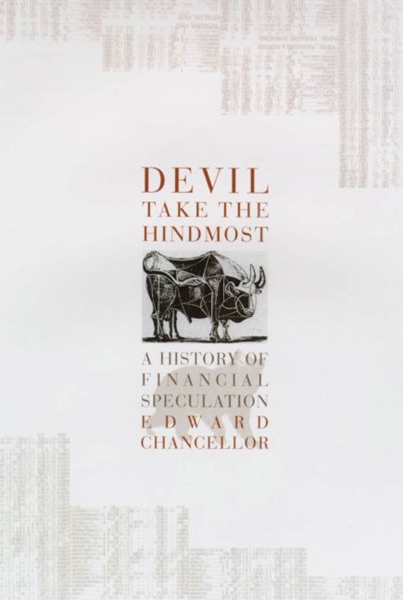
Talk to Devil Take the Hindmost: A History of Financial Speculation like its author wrote you back.
Get the ideas that fit your life — not generic summaries.
- Chat with the book
- Audiobook-style main ideas
- Adapts to your life and goals
- Helps you take action
Key takeaways
- 1.
Financial bubbles follow a recognizable pattern: a novel asset or technology, a compelling narrative, easy credit, and the gradual recruitment of the general public into speculation that professionals have already exited.
- 2.
The speculative impulse is not separate from capitalism but intrinsic to it. Periods of genuine productive investment are regularly accompanied by speculative fever that destroys wealth on a large scale.
- 3.
Easy credit is the enabling condition of most major speculative manias. When borrowing is cheap and assets are rising, leverage amplifies gains on the way up and losses on the way down.
- 4.
The belief that 'this time is different' is the most reliably recurring feature of financial manias. Each era has a new narrative for why the old rules of valuation no longer apply.
- 5.
Insiders consistently exit before the public arrives. The South Sea Bubble directors, the railroad promoters, the internet executives with lockup expiries — the people who know most are typically selling to the people who know least.
- 6.
Regulatory capture — the process by which the industries that should be regulated come to control their regulators — is a recurring feature of speculative episodes. Oversight typically fails when it is most needed.
- 7.
Crashes don't just destroy financial wealth. They destroy productive enterprises, disrupt credit for legitimate investment, and inflict lasting damage on individuals and communities that had nothing to do with the speculation.
- 8.
The nineteenth-century railroad manias financed infrastructure that had genuine long-term value, even as the speculation destroyed most investors. The question for each bubble is whether the underlying technology justifies any multiple, not whether it justifies the actual multiple.
Discussion questions
Use these on your own, with a book club, or as chat starters in Superbook. Book club version, ready to copy or print →
- 1.
Chancellor identifies the same pattern across four centuries of financial manias. What does the recurrence suggest about whether these patterns can be prevented, or whether they are simply endemic to financial markets?
- 2.
The South Sea Bubble destroyed thousands of ordinary investors while enriching its promoters. What institutional changes, if any, would have made a difference?
- 3.
The belief that 'this time is different' is identified as the core cognitive error of speculative manias. Have you ever held that belief about an investment or financial trend? What made it feel justified?
- 4.
Chancellor notes that the railroad manias funded infrastructure that still exists and generates value, even though investors lost money. How do we evaluate a bubble that destroys investors but creates real productive capacity?
- 5.
Insider selling — directors and executives exiting while retail investors arrive — is documented in every case in the book. What regulatory or legal frameworks have tried to address this, and why do they keep failing?
- 6.
Japan's lost decade followed one of the most extreme asset price bubbles in history. What does the Japanese case suggest about the long-term effects of a bubble of that magnitude?
- 7.
Chancellor was writing in 1999, just before the dot-com peak. What specific features of the late-1990s technology bubble does he identify, and how accurate was his implicit warning?
- 8.
The book ends before the 2008 financial crisis. Using Chancellor's framework, what were the features of the mortgage securitization bubble that fit the historical pattern?
- 9.
Financial history suggests that speculative manias occur regardless of regulatory environment. Does that mean regulation is futile, or does it mean that specific kinds of regulation are more effective than others?
- 10.
Which of the historical episodes Chancellor describes feels most analogous to financial dynamics you can observe in markets today?
- 11.
The title comes from a phrase used in early races — the winner takes all and the last-place finisher faces the worst consequences. Who are the 'hindmost' in a financial bubble, and is there a way to protect them?
Themes
Frequently asked questions
-
Is Devil Take the Hindmost worth reading?
Yes, especially for investors and anyone who wants to understand why financial manias keep recurring. It is more readable than academic economic history and more rigorously historical than most popular finance books. The case studies are vivid and individually instructive.
-
How does this compare to Charles Kindleberger's Manias, Panics, and Crashes?
Kindleberger is more analytical and framework-driven; Chancellor is more narrative and historical. The two books are complementary. Chancellor reads more easily; Kindleberger provides the theoretical scaffolding. Both are valuable for understanding financial history.
-
Was Chancellor predicting the dot-com crash?
The book was published in 1999 and the final chapter covers the emerging internet bubble with clear concern. He did not predict a specific crash date but the pattern analysis he presents in the final chapters reads as an implicit warning that arrived just before the NASDAQ peak.
-
Does the book cover cryptocurrency or recent bubbles?
No — it was published in 1999. But readers consistently find that his historical framework applies to bitcoin cycles, housing bubbles, and meme stock manias with minimal adjustment. The patterns are that durable.
-
Who should read this book?
Investors who want historical perspective on market cycles, general readers interested in economic history, and anyone who has ever found themselves caught in or near a speculative bubble and wants to understand what happened and why.
Similar books
Against the Gods: The Remarkable Story of Risk
Peter L. Bernstein
When Genius Failed
Roger Lowenstein
The Big Short: Inside the Doomsday Machine
Michael Lewis
Liar's Poker
Michael Lewis
