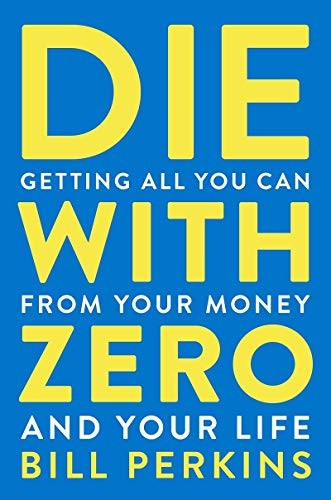
Talk to Die with Zero like its author wrote you back.
Get the ideas that fit your life — not generic summaries.
- Chat with the book
- Audiobook-style main ideas
- Adapts to your life and goals
- Helps you take action
Die with Zero, in detail
Die with Zero is Bill Perkins's argument that most people with means make a significant life mistake: they optimize for financial security and end up dying with far more money than they ever spent, having failed to convert accumulated wealth into meaningful experiences at the age when those experiences are most valuable. Perkins, an energy trader who became wealthy in his thirties, spent years watching colleagues accumulate vast wealth and then be unable to use it effectively when their health and mobility declined. The book is his case for a different optimization target: maximize the total of meaningful experiences across your life, not the balance in your account at death.
The central concept is the "memory dividend" — experiences generate positive memories that pay dividends through recollection and the stories you tell for years afterward. A trip taken at 30 pays memory dividends for decades. The same trip taken at 75, if your health allows it at all, has a shorter dividend window. The implication is that experiences have a time-sensitivity that financial assets do not, and that delaying experiences to accumulate more money is often an objectively poor tradeoff.
Perkins organizes his prescription around several principles: give money to children and causes when it can do the most good (typically earlier in their lives, not at your death), invest in experiences when you have health and energy (typically earlier, not later), work only as long as the work produces satisfaction proportional to what it costs in time and vitality, and think in terms of life stages with different spending patterns rather than a single trajectory of accumulation followed by decumulation.
The book's argument requires pushback on two fronts. First, it is clearly aimed at people who have accumulated or will accumulate more than enough — people who are saving aggressively enough that they risk dying rich. For people who are not on that trajectory, the advice is less applicable. Second, the "die with zero" instruction is hyperbolic: Perkins explicitly advocates for insurance against catastrophic medical expenses and for a reasonable cushion against unexpected longevity. The provocative title is more literally aggressive than the actual advice.
The big ideas
- 1.
Money unspent is life unlived. Optimizing for maximum account balance at death is an error that trades real experiences for numbers in an account.
- 2.
Memory dividends are real: experiences generate ongoing positive returns through recollection, stories, and relationships. Delaying valuable experiences reduces the total return.
- 3.
Experiences have optimal ages. Health and mobility enable certain experiences at 40 that may be impossible at 70. Timing matters as much as the decision to have the experience at all.
