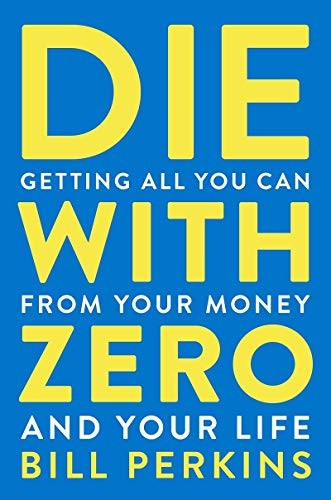
Die with Zero by Bill Perkins is a 2020 self-help book about life optimization, spending philosophy, memory dividends. Money unspent is life unlived. Optimizing for maximum account balance at death is an error that trades real experiences for numbers in an account.
Summary
Die with Zero is Bill Perkins's argument that most people with means make a significant life mistake: they optimize for financial security and end up dying with far more money than they ever spent, having failed to convert accumulated wealth into meaningful experiences at the age when those experiences are most valuable. Perkins, an energy trader who became wealthy in his thirties, spent years watching colleagues accumulate vast wealth and then be unable to use it effectively when their health and mobility declined. The book is his case for a different optimization target: maximize the total of meaningful experiences across your life, not the balance in your account at death.
The central concept is the "memory dividend" — experiences generate positive memories that pay dividends through recollection and the stories you tell for years afterward. A trip taken at 30 pays memory dividends for decades. The same trip taken at 75, if your health allows it at all, has a shorter dividend window. The implication is that experiences have a time-sensitivity that financial assets do not, and that delaying experiences to accumulate more money is often an objectively poor tradeoff.
Perkins organizes his prescription around several principles: give money to children and causes when it can do the most good (typically earlier in their lives, not at your death), invest in experiences when you have health and energy (typically earlier, not later), work only as long as the work produces satisfaction proportional to what it costs in time and vitality, and think in terms of life stages with different spending patterns rather than a single trajectory of accumulation followed by decumulation.
The book's argument requires pushback on two fronts. First, it is clearly aimed at people who have accumulated or will accumulate more than enough — people who are saving aggressively enough that they risk dying rich. For people who are not on that trajectory, the advice is less applicable. Second, the "die with zero" instruction is hyperbolic: Perkins explicitly advocates for insurance against catastrophic medical expenses and for a reasonable cushion against unexpected longevity. The provocative title is more literally aggressive than the actual advice.
Talk to Die with Zero like its author wrote you back.
Get the ideas that fit your life — not generic summaries.
- Chat with the book
- Audiobook-style main ideas
- Adapts to your life and goals
- Helps you take action
Key takeaways
- 1.
Money unspent is life unlived. Optimizing for maximum account balance at death is an error that trades real experiences for numbers in an account.
- 2.
Memory dividends are real: experiences generate ongoing positive returns through recollection, stories, and relationships. Delaying valuable experiences reduces the total return.
- 3.
Experiences have optimal ages. Health and mobility enable certain experiences at 40 that may be impossible at 70. Timing matters as much as the decision to have the experience at all.
- 4.
Give money to your children and causes when it can actually change their lives, not at your death when they may already be well established. The impact of money is time-sensitive.
- 5.
Work only as long as the exchange is favorable. At some point in every successful career, the marginal utility of more money is lower than the utility of more time.
- 6.
Think in life buckets, not years. Different decades have different optimal spending patterns and different health profiles. Planning in terms of decades helps avoid the trap of uniform accumulation.
- 7.
The real enemy is not poverty in retirement — it's having too little vitality to spend the money you have. Health and energy are the binding constraints, not financial ones, for the over-savers this book addresses.
- 8.
The net-worth peak should be somewhere in your 60s, not at death. A plan that ends with a significant estate is a plan that failed to convert money into life.
Discussion questions
Use these on your own, with a book club, or as chat starters in Superbook. Book club version, ready to copy or print →
- 1.
Perkins argues that dying with money unspent is a mistake. Does that framing resonate with you, or do you value leaving assets to family or causes enough that it changes the argument?
- 2.
The memory dividend concept suggests that experiences have diminishing value if delayed. What experience have you delayed that would have been better if you had done it earlier?
- 3.
Perkins is a wealthy energy trader writing for people who are likely to over-save. Is the book's advice applicable to you specifically, given your actual financial trajectory?
- 4.
The 'optimal age for experiences' argument implies a spending peak in middle age. Does your current spending pattern reflect the idea that experiences are time-sensitive?
- 5.
Perkins recommends giving money to children and causes when it can change their lives, not at death. What is your thinking about inheritance and charitable giving in terms of timing and impact?
- 6.
The book's prescription is deliberately provocative — work less, spend more, optimize for life rather than net worth. What would you actually change in your life if you internalized that prescription?
- 7.
How do you distinguish between spending on experiences that generate genuine memory dividends and spending on consumption that provides transient pleasure without lasting return?
- 8.
The fear of running out of money in old age is one of the most powerful financial anxieties. Does Perkins adequately address that fear, or does his advice underweight catastrophic longevity risk?
- 9.
What is the work you are currently doing that you would stop if you had enough money? And if you're honest: how much is 'enough' in your case?
- 10.
Perkins suggests your net worth should peak in your 60s. Does your current financial plan peak around then, much later, or does this way of thinking about the timeline feel foreign?
- 11.
The book is about life optimization, not just financial optimization. What metric beyond net worth captures what you're actually trying to maximize in your financial decisions?
- 12.
The die-with-zero instruction is an exaggeration of the actual advice. After accounting for a catastrophic-expense reserve and a longevity buffer, how much of a residual estate would you be comfortable leaving?
Themes
Frequently asked questions
-
Is Die with Zero telling me to blow all my savings?
No. Perkins explicitly recommends maintaining insurance against catastrophic health expenses and a buffer against unexpectedly long life. The 'zero' is a direction, not a literal instruction — the argument is to avoid dying with substantial unspent wealth when you could have used it for meaningful experiences during your healthier years.
-
Who is Die with Zero for?
People who are on track to accumulate more money than they will spend — the over-savers rather than the under-savers. The book's core problem only applies if you are saving more than necessary for a comfortable retirement. For people struggling to save enough, the conventional advice (save more) is still right.
-
What is a memory dividend?
Perkins's term for the ongoing positive returns an experience generates through recollection, storytelling, and the way it shapes your identity and relationships. A trip to Japan at 35 generates decades of memories, conversations, and possibly relationships. That ongoing return is the 'dividend' on the investment in the experience.
-
How does Die with Zero change retirement planning?
It argues for a spending pattern that peaks in the middle decades and declines in later retirement, rather than the conventional approach of steady accumulation followed by drawing down a constant amount. It also implies spending significantly before traditional retirement age rather than deferring all major experiences to afterward.
-
Does the book address what to invest in?
Minimally. Die with Zero is not an investment guide — it is a life philosophy guide about when and how to spend money, not how to grow it. The investment question is essentially deferred to other books. Perkins's assumption is that you are competent at accumulation and need to be challenged on spending.