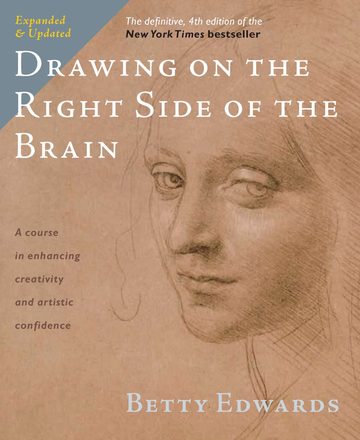
Talk to Drawing on the Right Side of the Brain like its author wrote you back.
Get the ideas that fit your life — not generic summaries.
- Chat with the book
- Audiobook-style main ideas
- Adapts to your life and goals
- Helps you take action
What it argues
Drawing on the Right Side of the Brain rests on a claim that has quietly reassured millions of self-declared non-artists: drawing is not a gift you're born with but a learnable skill, and it is a skill of seeing rather than of the hand. Betty Edwards, a veteran art teacher, noticed that students who 'couldn't draw' were really failing to perceive what was in front of them — their hands were fine. Her book is a course designed to fix the seeing, and it became one of the best-selling art-instruction books ever written.
The obstacle, she argues, is the mind's verbal, analytical mode — which she labeled, borrowing the split-brain research popular in the 1970s, the 'left brain' or L-mode. This mode is a champion at naming and symbolizing, and it sabotages drawing by substituting stored symbols (the schematic eye, nose and hand we settled on as children) for the specific shapes actually before us. To draw well you must shift into a different, non-verbal, spatial and holistic mode — R-mode — in which you stop naming things and simply record what you see. Much of the book is exercises engineered to trigger that shift, from copying a Picasso portrait upside down to contour drawing without looking at the page.
What it gets right
- 1.
Drawing is a learnable skill, not an inborn talent — and it's mostly a skill of perception, not manual dexterity. Your hand can already do it; your seeing needs training.
- 2.
The real obstacle is the mind's naming, symbolizing mode, which substitutes childhood symbols (a schematic eye, a stick hand) for the actual shapes in front of you.
- 3.
Learning to draw means shifting into a non-verbal, spatial mode of attention where you stop labeling objects and record only what you actually see.
What it covers
Who wrote it
Betty Edwards is an American art teacher and author who spent much of her career at California State University, Long Beach, where she developed and tested the perceptual approach to drawing that made her famous. She holds a doctorate in art, education and the psychology of perception, and drew on the era's split-brain research to frame drawing as a shift in cognitive mode. First published in 1979 and revised several times since, Drawing on the Right Side of the Brain has sold millions of copies worldwide, been translated into more than a dozen languages, and become a standard text in beginning-drawing instruction.
