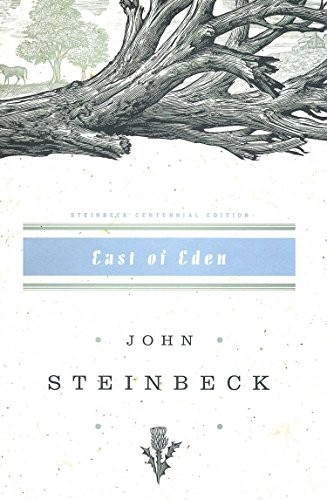
Talk to East of Eden like its author wrote you back.
Get the ideas that fit your life — not generic summaries.
- Chat with the book
- Audiobook-style main ideas
- Adapts to your life and goals
- Helps you take action
What it argues
East of Eden is Steinbeck's self-declared masterwork, a long and ambitious novel published in 1952 that traces two families — the Trasks and the Hamiltons — across two generations in California's Salinas Valley. It is a retelling of the Cain and Abel story, and Steinbeck is upfront about this; he discusses the Genesis narrative in the novel itself, through the character of Lee, a Chinese American servant of exceptional wisdom and learning. The central argument is encoded in a single Hebrew word, timshel — "thou mayest" — which Steinbeck and his characters take to mean that human beings are not condemned to their natures. They may choose to overcome them.
The two narrative threads are the Trask family, whose story echoes the Bible — Charles and Adam as Cain and Abel, then Adam's twin sons Cal and Aron repeating the pattern in the next generation — and the Hamiltons, who are based on Steinbeck's own family. The Hamiltons are warmer and more episodic; the Trasks carry the novel's mythic weight. At the center of the Trask story is Cathy Ames, one of the most fully developed villains in American fiction: cold, manipulative, capable of genuine evil, and given a psychological interiority that Steinbeck treats with unsettling seriousness. She is not merely a plot mechanism but an argument about whether some people are simply born wrong.
What it gets right
- 1.
Timshel — 'thou mayest' — is the novel's central claim: not that humans will overcome their nature, but that they may. The possibility of choice is the only thing that makes morality meaningful.
- 2.
Cathy Ames is presented as a near-psychopathic figure, but Steinbeck resists making her purely symbolic — her psychology is examined, not simply deployed. This makes her more disturbing than a stock villain.
- 3.
The Cain and Abel pattern repeats across generations (Charles/Adam, Cal/Aron) to argue that the inheritance of family dynamics is not destiny. The second generation may choose differently.
What it covers
Who wrote it
John Steinbeck (1902–1968) was an American novelist and short story writer born in Salinas, California, the setting of East of Eden. He worked as a laborer, journalist, and war correspondent before his fiction drew national attention. His major works include Of Mice and Men, The Grapes of Wrath, Cannery Row, and Travels with Charley. The Grapes of Wrath won the Pulitzer Prize in 1940, and Steinbeck was awarded the Nobel Prize in Literature in 1962. He considered East of Eden, published in 1952, the book he had spent his life preparing to write.
