Talk to Economics in One Lesson like its author wrote you back.
Get the ideas that fit your life — not generic summaries.
- Chat with the book
- Audiobook-style main ideas
- Adapts to your life and goals
- Helps you take action
What it argues
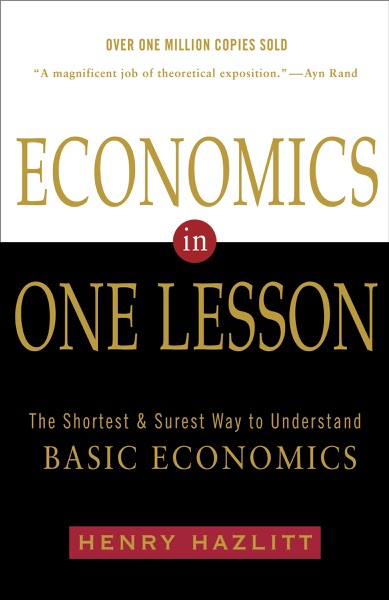
Henry Hazlitt wrote Economics in One Lesson in 1946, based on a single insight he credited to the nineteenth-century French economist Frédéric Bastiat: the difference between a good economist and a bad economist is that the good economist considers the effects of a policy on all groups, not just the immediately visible beneficiaries, and over the long run, not just the immediate term. The broken window fallacy — the idea that destroying a window creates economic benefit because someone must pay the glazier — is Bastiat's central example, and Hazlitt extends it across two dozen policy domains.
The structure of the book is simple and consistent. Each chapter presents a policy — tariffs, price controls, rent regulation, minimum wages, public works spending, subsidies to particular industries — and applies the same lens: who benefits visibly and immediately, and what are the unseen costs? The glazier gains, but the shoemaker who would have been paid instead does not. The union member who wins a higher wage gains, but the worker who cannot find employment at the higher wage does not. The domestic steel industry protected by a tariff gains, but the consumers and industries that pay more for steel do not.
What it gets right
- 1.
The one lesson: the art of economics is considering the effects of any policy on all groups, not just the immediately visible ones, and over time, not just immediately.
- 2.
The broken window fallacy: destruction does not create wealth. The money spent on repair is money not spent on something that would have been created instead.
- 3.
Tariffs protect the seen jobs in favored industries while destroying the unseen jobs elsewhere and raising prices for consumers.
What it covers
Who wrote it
Henry Hazlitt (1894–1993) was an American journalist, literary critic, and economic commentator. He worked as an editor and writer at The Nation, The New York Evening Mail, The New York Sun, and Newsweek, where he wrote a weekly economics column for over two decades. Largely self-taught in economics, he became one of the most widely read popular expositors of free-market ideas in the twentieth century. He was a founding vice president of the Foundation for Economic Education and translated and introduced Bastiat's work to English-language audiences. Economics in One Lesson, first published in 1946, has sold more than one million copies.
