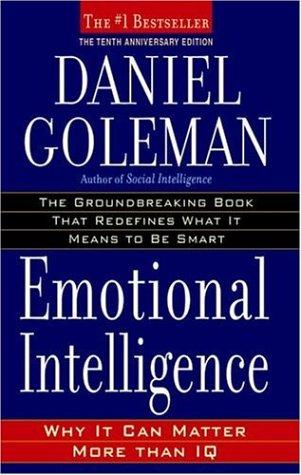
Talk to Emotional Intelligence like its author wrote you back.
Get the ideas that fit your life — not generic summaries.
- Chat with the book
- Audiobook-style main ideas
- Adapts to your life and goals
- Helps you take action
What it argues
Daniel Goleman's Emotional Intelligence, published in 1995, made a widely influential argument: that the cluster of abilities involved in managing emotions — self-awareness, self-regulation, empathy, and social skill — predicts life outcomes at least as well as IQ, and possibly better in many domains. The book drew heavily on neuroscience research of the early 1990s, particularly on the amygdala's role in emotional hijacking, and built a case for emotional competence as something that could be taught and learned rather than fixed at birth.
The neuroscience section in the first half is the book's empirical foundation. Goleman explains how the amygdala can trigger fear, rage, and intense emotion before the cortex has fully processed what is happening — what he calls the amygdala hijack. He explains how the prefrontal cortex modulates these responses, and how early attachment and childhood experience shape the neural circuits involved. This part of the book draws on LeDoux's work on fear, Ekman's on facial expressions, and Salovey and Mayer's on emotional intelligence as a construct.
What it gets right
- 1.
IQ is not destiny. Emotional intelligence — the ability to recognize, manage, and use emotions effectively — is a better predictor of long-term success in many domains.
- 2.
The amygdala hijack occurs when emotional arousal overwhelms the prefrontal cortex's capacity to regulate it. Recognizing the hijack is the first step to managing it.
- 3.
Self-awareness — knowing what you feel as you feel it — is the foundation of emotional intelligence. Without it, self-regulation, empathy, and social skill all become harder.
What it covers
Who wrote it
Daniel Goleman is a science journalist and psychologist who wrote for the New York Times for a dozen years before publishing Emotional Intelligence in 1995. He has since written extensively on emotional and social intelligence, leadership, and ecological awareness, including Social Intelligence, Working with Emotional Intelligence, and Focus. He co-founded the Collaborative for Academic, Social, and Emotional Learning (CASEL), which has shaped how social-emotional learning is taught in schools worldwide. He holds a PhD in psychology from Harvard.
