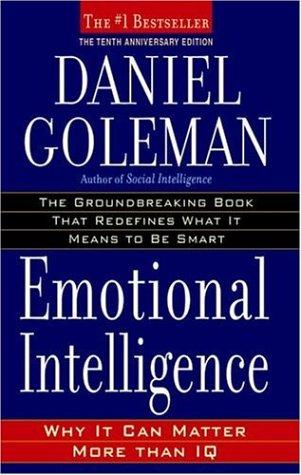
Emotional Intelligence by Daniel Goleman is a 1995 psychology book about emotional intelligence, self-awareness, empathy. IQ is not destiny. Emotional intelligence — the ability to recognize, manage, and use emotions effectively — is a better predictor of long-term success in many domains.
Summary
Daniel Goleman's Emotional Intelligence, published in 1995, made a widely influential argument: that the cluster of abilities involved in managing emotions — self-awareness, self-regulation, empathy, and social skill — predicts life outcomes at least as well as IQ, and possibly better in many domains. The book drew heavily on neuroscience research of the early 1990s, particularly on the amygdala's role in emotional hijacking, and built a case for emotional competence as something that could be taught and learned rather than fixed at birth.
The neuroscience section in the first half is the book's empirical foundation. Goleman explains how the amygdala can trigger fear, rage, and intense emotion before the cortex has fully processed what is happening — what he calls the amygdala hijack. He explains how the prefrontal cortex modulates these responses, and how early attachment and childhood experience shape the neural circuits involved. This part of the book draws on LeDoux's work on fear, Ekman's on facial expressions, and Salovey and Mayer's on emotional intelligence as a construct.
The second half turns prescriptive: what emotional intelligence looks like in childhood development, in schools, in relationships, and in the workplace. Goleman argues that empathy, impulse control, and the ability to delay gratification are trainable and that schools should teach them deliberately. He documents programs that have improved emotional literacy in children with measurable results in academic performance and social behavior.
The concept of emotional intelligence has been both influential and contested since the book's publication. Critics note that the construct as Goleman defines it is broad enough to encompass nearly any interpersonal virtue, making it hard to measure reliably, and that the predictive validity claims are stronger than the research at the time warranted. Nonetheless, the book changed how schools, organizations, and individuals think about the relationship between emotional life and performance. Emotional Intelligence introduced a vocabulary — EQ, emotional hijacking, empathy as skill — that has entered common usage and shaped three decades of applied psychology.
Talk to Emotional Intelligence like its author wrote you back.
Get the ideas that fit your life — not generic summaries.
- Chat with the book
- Audiobook-style main ideas
- Adapts to your life and goals
- Helps you take action
Key takeaways
- 1.
IQ is not destiny. Emotional intelligence — the ability to recognize, manage, and use emotions effectively — is a better predictor of long-term success in many domains.
- 2.
The amygdala hijack occurs when emotional arousal overwhelms the prefrontal cortex's capacity to regulate it. Recognizing the hijack is the first step to managing it.
- 3.
Self-awareness — knowing what you feel as you feel it — is the foundation of emotional intelligence. Without it, self-regulation, empathy, and social skill all become harder.
- 4.
Empathy requires the ability to read others' emotional states through facial expression, tone, and body language. This skill is trainable from early childhood.
- 5.
Impulse control in childhood predicts adult outcomes including income, health, and relationship stability. Walter Mischel's marshmallow experiments are the most cited evidence.
- 6.
Emotional intelligence in the workplace involves managing emotional climate as much as managing tasks. Leaders who lack it create environments that suppress performance.
- 7.
Children can be taught emotional literacy — to name emotions, to understand their causes, to manage conflict — and these skills have measurable effects on academic and social outcomes.
- 8.
Early relationships wire the neural circuits underlying emotional response. Secure attachment promotes the regulatory capacities that constitute emotional intelligence; insecure attachment impairs them.
Discussion questions
Use these on your own, with a book club, or as chat starters in Superbook. Book club version, ready to copy or print →
- 1.
Goleman argues that EQ predicts success better than IQ in many domains. Does that match your observation of people you know — are the most successful people in your experience the most emotionally intelligent?
- 2.
The amygdala hijack describes a moment when emotion overrides reason. Can you identify a pattern in your own experience of when that happens and what triggers it?
- 3.
Self-awareness is described as the foundation of emotional intelligence. What practices in your life — if any — actually build it, rather than just feeling like they do?
- 4.
Empathy is presented as a trainable skill, not a personality trait. Do you believe your capacity for empathy has changed over your lifetime? What caused those changes?
- 5.
The marshmallow test correlates impulse control at age four with life outcomes at twenty. What do you make of that finding? Does it feel like a fact about the world or a story that proves too much?
- 6.
Goleman criticizes schools for prioritizing cognitive skills while ignoring emotional development. What would it look like for emotional literacy to be genuinely taught in education?
- 7.
The book was written in 1995. How has the concept of emotional intelligence aged? What parts feel more established and what parts feel overstated?
- 8.
He argues that emotional intelligence can be developed throughout life. Is there an emotional competency you have worked on as an adult? What made that development possible?
- 9.
Goleman distinguishes between cognitive empathy — understanding another's mental state — and emotional empathy — feeling what they feel. Which do you find easier? Which do you think matters more?
- 10.
What is the relationship between emotional intelligence and manipulation? Is it possible to be high in EQ and use those skills to exploit rather than connect?
- 11.
Which of the five components Goleman identifies — self-awareness, self-regulation, motivation, empathy, social skill — do you most want to develop?
- 12.
The book's ideas have shaped workplace culture significantly. How do you see emotional intelligence valued or devalued in the organizations you know?
Themes
Frequently asked questions
-
What are the five components of emotional intelligence?
Self-awareness, self-regulation, motivation, empathy, and social skill. Goleman treats these as a hierarchy: self-awareness underlies the others, and social skill is the outward expression of the earlier capacities.
-
Is the EQ concept scientifically validated?
Contested. The original scientific construct from Salovey and Mayer is more narrowly defined than Goleman's and has more empirical support. Goleman's broader version has been criticized for including too much — nearly any interpersonal virtue — making it hard to test.
-
Is this book still relevant?
The core argument — that emotional awareness and regulation matter enormously for life outcomes — is well supported by subsequent research. Some of the specific neuroscience has been revised, and the predictive claims are stronger in the book than the evidence warranted at the time.
-
Who should read it?
Anyone in a role that involves managing people, raising children, or working in education. Also useful for anyone who has noticed emotional responses derailing their goals and wants a framework for understanding why.
-
What is the most actionable idea?
Recognizing the amygdala hijack — the moment when strong emotion overrides clear thinking — and developing a pause between stimulus and response. This is the beginning of self-regulation.
Similar books

Nonviolent Communication
Marshall B. Rosenberg
How Emotions Are Made: The Secret Life of the Brain
Lisa Feldman Barrett
Primal Leadership
Daniel Goleman, Richard Boyatzis, and Annie McKee
Stumbling on Happiness
Daniel Gilbert
