Talk to Emotional Intelligence like its author wrote you back.
Get the ideas that fit your life — not generic summaries.
- Chat with the book
- Audiobook-style main ideas
- Adapts to your life and goals
- Helps you take action
Emotional Intelligence, in detail
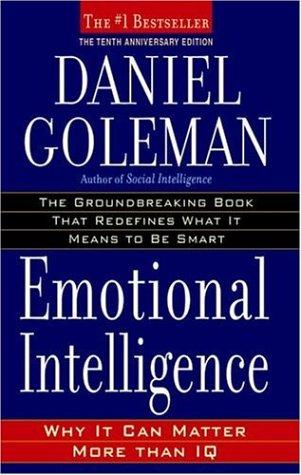
Daniel Goleman's Emotional Intelligence, published in 1995, made a widely influential argument: that the cluster of abilities involved in managing emotions — self-awareness, self-regulation, empathy, and social skill — predicts life outcomes at least as well as IQ, and possibly better in many domains. The book drew heavily on neuroscience research of the early 1990s, particularly on the amygdala's role in emotional hijacking, and built a case for emotional competence as something that could be taught and learned rather than fixed at birth.
The neuroscience section in the first half is the book's empirical foundation. Goleman explains how the amygdala can trigger fear, rage, and intense emotion before the cortex has fully processed what is happening — what he calls the amygdala hijack. He explains how the prefrontal cortex modulates these responses, and how early attachment and childhood experience shape the neural circuits involved. This part of the book draws on LeDoux's work on fear, Ekman's on facial expressions, and Salovey and Mayer's on emotional intelligence as a construct.
The second half turns prescriptive: what emotional intelligence looks like in childhood development, in schools, in relationships, and in the workplace. Goleman argues that empathy, impulse control, and the ability to delay gratification are trainable and that schools should teach them deliberately. He documents programs that have improved emotional literacy in children with measurable results in academic performance and social behavior.
The concept of emotional intelligence has been both influential and contested since the book's publication. Critics note that the construct as Goleman defines it is broad enough to encompass nearly any interpersonal virtue, making it hard to measure reliably, and that the predictive validity claims are stronger than the research at the time warranted. Nonetheless, the book changed how schools, organizations, and individuals think about the relationship between emotional life and performance. Emotional Intelligence introduced a vocabulary — EQ, emotional hijacking, empathy as skill — that has entered common usage and shaped three decades of applied psychology.
The big ideas
- 1.
IQ is not destiny. Emotional intelligence — the ability to recognize, manage, and use emotions effectively — is a better predictor of long-term success in many domains.
- 2.
The amygdala hijack occurs when emotional arousal overwhelms the prefrontal cortex's capacity to regulate it. Recognizing the hijack is the first step to managing it.
- 3.
Self-awareness — knowing what you feel as you feel it — is the foundation of emotional intelligence. Without it, self-regulation, empathy, and social skill all become harder.
