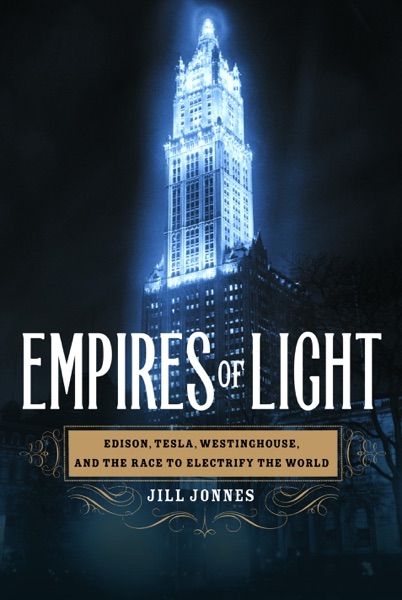
Talk to Empires of Light like its author wrote you back.
Get the ideas that fit your life — not generic summaries.
- Chat with the book
- Audiobook-style main ideas
- Adapts to your life and goals
- Helps you take action
Empires of Light, in detail
Empires of Light is Jill Jonnes's history of the War of Currents — the late-nineteenth-century battle between Thomas Edison's direct-current electrical system and George Westinghouse's alternating-current system, with Nikola Tesla as the third figure whose genius made AC practical. It's a business and technology story, but also a story about ego, capital, and how major infrastructure decisions get made in the absence of technical consensus.
Jonnes structures the book around three protagonists. Edison is portrayed as a brilliant but increasingly stubborn businessman who had too much invested in direct current to evaluate AC honestly. He waged a PR campaign against AC that included publicly electrocuting animals — including an elephant — to demonstrate its dangers. Westinghouse is the industrialist who recognized the commercial potential of AC and had the organizational capacity to deploy it. Tesla is the tragic genius: a visionary inventor who designed the AC induction motor and polyphase system that made long-distance power transmission possible, then signed away his royalties to save Westinghouse's company and died poor.
The book's centerpiece is the 1893 Chicago World's Fair, where Westinghouse and Tesla lit the fairgrounds with AC current and demonstrated beyond any practical doubt that DC could not compete at scale. Edison's defeat was partly technological and partly financial: J.P. Morgan eventually withdrew support from Edison Electric and merged it into what became General Electric, which promptly licensed Tesla's AC patents. The man who lost the current war ended up in a company that commercialized what beat him.
Jonnes writes energetically and has a gift for making technical material accessible without oversimplifying it. The biographical sections on Tesla are particularly strong — his eccentricities, his genuine scientific contributions, and his exploitation by more commercially minded men are all handled with sympathy and fairness. The book is less strong on the economic and policy dimensions of electrification, but as a narrative history of a pivotal technological contest it's a reliable and enjoyable account.
The big ideas
- 1.
The War of Currents was decided less by technical superiority than by economics: AC could transmit power over long distances at much lower cost, which made Edison's position untenable regardless of his PR efforts.
- 2.
Edison's campaign against AC — including public animal electrocutions — is a case study in how incumbents use fear and misinformation to slow the adoption of superior competing technologies.
- 3.
Tesla's AC induction motor and polyphase system were genuine scientific breakthroughs. Without them, long-distance electrical transmission would have required a different approach or more time to develop.
