Empires of Light by Jill Jonnes is a 2003 history book about innovation, electricity, industrial history. The War of Currents was decided less by technical superiority than by economics: AC could transmit power over long distances at much lower cost, which made Edison's position untenable regardless of his PR efforts.
Summary
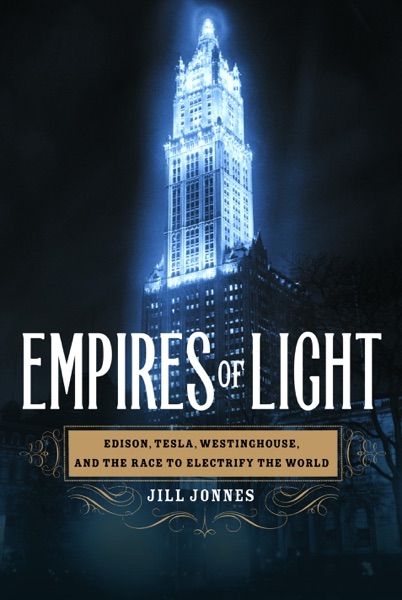
Empires of Light is Jill Jonnes's history of the War of Currents — the late-nineteenth-century battle between Thomas Edison's direct-current electrical system and George Westinghouse's alternating-current system, with Nikola Tesla as the third figure whose genius made AC practical. It's a business and technology story, but also a story about ego, capital, and how major infrastructure decisions get made in the absence of technical consensus.
Jonnes structures the book around three protagonists. Edison is portrayed as a brilliant but increasingly stubborn businessman who had too much invested in direct current to evaluate AC honestly. He waged a PR campaign against AC that included publicly electrocuting animals — including an elephant — to demonstrate its dangers. Westinghouse is the industrialist who recognized the commercial potential of AC and had the organizational capacity to deploy it. Tesla is the tragic genius: a visionary inventor who designed the AC induction motor and polyphase system that made long-distance power transmission possible, then signed away his royalties to save Westinghouse's company and died poor.
The book's centerpiece is the 1893 Chicago World's Fair, where Westinghouse and Tesla lit the fairgrounds with AC current and demonstrated beyond any practical doubt that DC could not compete at scale. Edison's defeat was partly technological and partly financial: J.P. Morgan eventually withdrew support from Edison Electric and merged it into what became General Electric, which promptly licensed Tesla's AC patents. The man who lost the current war ended up in a company that commercialized what beat him.
Jonnes writes energetically and has a gift for making technical material accessible without oversimplifying it. The biographical sections on Tesla are particularly strong — his eccentricities, his genuine scientific contributions, and his exploitation by more commercially minded men are all handled with sympathy and fairness. The book is less strong on the economic and policy dimensions of electrification, but as a narrative history of a pivotal technological contest it's a reliable and enjoyable account.
Talk to Empires of Light like its author wrote you back.
Get the ideas that fit your life — not generic summaries.
- Chat with the book
- Audiobook-style main ideas
- Adapts to your life and goals
- Helps you take action
Key takeaways
- 1.
The War of Currents was decided less by technical superiority than by economics: AC could transmit power over long distances at much lower cost, which made Edison's position untenable regardless of his PR efforts.
- 2.
Edison's campaign against AC — including public animal electrocutions — is a case study in how incumbents use fear and misinformation to slow the adoption of superior competing technologies.
- 3.
Tesla's AC induction motor and polyphase system were genuine scientific breakthroughs. Without them, long-distance electrical transmission would have required a different approach or more time to develop.
- 4.
The 1893 Chicago World's Fair was a turning point: lighting an entire world's fair with AC demonstrated reliability and scale in a setting with maximum public visibility.
- 5.
Westinghouse's organizational capacity mattered as much as Tesla's inventions. Good ideas need industrial infrastructure and capital to become systems.
- 6.
Tesla signed away his AC royalties to save Westinghouse from financial collapse. The gesture was loyal and commercially disastrous for him personally.
- 7.
J.P. Morgan's financing decisions shaped which electrical system won. Capital allocation in infrastructure transitions has political and personal dimensions that are often as important as the underlying technology.
- 8.
Edison was eventually pushed out of electrical power — his company merged into General Electric, which then licensed the AC technology that had defeated him. Winners can absorb the innovations of their competitors.
Discussion questions
Use these on your own, with a book club, or as chat starters in Superbook. Book club version, ready to copy or print →
- 1.
Edison knew DC had serious limitations but fought AC anyway. What personal and financial incentives explain his resistance, and are they understandable?
- 2.
Jonnes portrays Tesla as a genius who was repeatedly exploited by more commercially minded men. Does the record support that characterization, or is it too simple?
- 3.
How did the Chicago World's Fair function as a technology demonstration, and what similar product or technology demonstrations in more recent history have played a comparable role?
- 4.
The War of Currents involved propaganda, staged events, and deliberate misinformation. What does the campaign against AC suggest about how technological change is contested?
- 5.
Westinghouse matched Tesla's technical vision with organizational and capital resources. Can you think of examples where technical brilliance without that backing led to lost opportunities?
- 6.
Tesla signed away enormous royalties to save Westinghouse's company. How do you evaluate that decision — as nobility, naivety, or something more complicated?
- 7.
Morgan's role in reshaping Edison's company illustrates how financial power shapes technology outcomes. What current technology markets show similar patterns?
- 8.
Jonnes gives considerable attention to the personalities of all three protagonists. Do you think biographical focus helps or obscures understanding of a technological transition of this kind?
- 9.
The AC victory was clear by the late 1890s. Why did it take as long as it did for the market to settle?
- 10.
What parallels do you see between the War of Currents and current disputes over energy infrastructure — electric vehicles, solar, grid design?
- 11.
The book ends with Tesla in decline and obscurity. What made his story so different from Edison's or Westinghouse's, despite his greater technical contributions?
- 12.
Infrastructure decisions made in the 1890s shaped how electricity reached homes and businesses for over a century. What infrastructure decisions being made now might have similar long-term lock-in?
Themes
Frequently asked questions
-
Is Empires of Light accurate about Tesla?
Largely yes. Jonnes relies on primary sources and is careful to distinguish documented facts from the myths that have accumulated around Tesla. She credits him accurately for the AC induction motor and polyphase system while not exaggerating his contributions beyond the record.
-
How long does it take to read Empires of Light?
Around six to seven hours. At roughly 370 pages of text (not counting notes), it moves quickly for a work of this historical depth. The technical sections are written accessibly enough that a non-specialist can follow them.
-
Do I need any electrical engineering background to follow the book?
No. Jonnes explains the key technical concepts — direct vs. alternating current, transmission losses, the induction motor — clearly enough for general readers. The book is primarily a narrative history, not a technical one.
-
Who should read Empires of Light?
Readers interested in the history of technology, industrial capitalism, or American history in the Gilded Age. It's also a useful read for anyone thinking about how major technological transitions happen and what determines which technologies win.
-
What's the book's main limitation?
Jonnes focuses on the three central figures and their immediate contest. Broader questions about the social and political economy of electrification — who got access to power and when, how rates were set, the role of municipal utilities — receive limited treatment. For those questions, other sources are needed.
Similar books
The Innovators: How a Group of Hackers, Geniuses, and Geeks Created the Digital Revolution
Walter Isaacson
The Soul of a New Machine
Tracy Kidder
Thunderstruck
Erik Larson
Dead Wake: The Last Crossing of the Lusitania
Erik Larson
