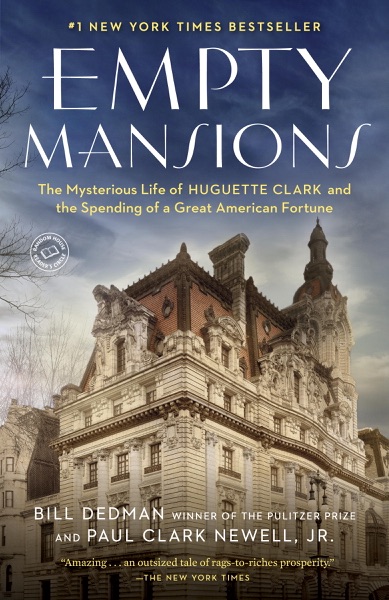
Talk to Empty Mansions like its author wrote you back.
Get the ideas that fit your life — not generic summaries.
- Chat with the book
- Audiobook-style main ideas
- Adapts to your life and goals
- Helps you take action
Empty Mansions, in detail
Empty Mansions is the biography of Huguette Clark, an extraordinarily wealthy woman who died in 2011 at the age of 104, having spent the last twenty years of her life in a hospital room she chose not to leave despite being in good health and owning a Santa Barbara estate, a Fifth Avenue apartment, and a Connecticut mansion — all maintained, staffed, and largely unvisited. Pulitzer Prize-winning journalist Bill Dedman and Huguette's cousin Paul Clark Newell Jr. spent years reconstructing her life from court records, private letters, interviews, and the estates themselves.
The story has two threads. One is Huguette herself: born in 1906 to William Andrews Clark, one of the wealthiest men in America (copper magnate, Senator from Montana, art collector), she grew up in an era of Gilded Age extravagance before retreating progressively from public life following the death of her younger sister and, later, her mother. Huguette never had close friends as an adult, never married (her marriage in 1928 lasted nine months), and spent her later decades painting in her apartment, maintaining correspondence with a small number of people, and ordering dollhouses and French chateau models for a collection she rarely showed anyone.
The second thread is the legal drama that followed her death. Huguette left an estate worth hundreds of millions of dollars, and a disputed will divided it between her distant family and her hospital nurse, doctor, and attorney, who had maintained personal relationships with her during her two decades in the hospital. The legal proceedings revealed the details of her last years and raised uncomfortable questions about how isolated wealthy elderly people are protected — or failed to be protected — by those around them.
Dedman writes with the discipline of an investigative reporter, but the book is also genuinely moving. Huguette's story is not really about money — it's about a life shaped by early loss, an extreme temperament, and a kind of voluntary exile from normal human connection. Her three properties were maintained for decades as if she might arrive any day; she never did. The image of those empty mansions, furnished and ready, is the book's governing metaphor.
The big ideas
- 1.
Huguette Clark was the daughter of one of Gilded Age America's wealthiest men and outlived him by eight decades, dying in 2011 at 104 while her three properties sat empty and staffed.
- 2.
She chose to spend her last twenty years in a hospital room despite being healthy enough to leave, preferring the contained, controlled world of her room to the larger one outside.
- 3.
William Andrews Clark, Huguette's father, built a copper fortune and became a senator through a combination of business genius and unabashed bribery — one of the Gilded Age's least flattering portraits.
