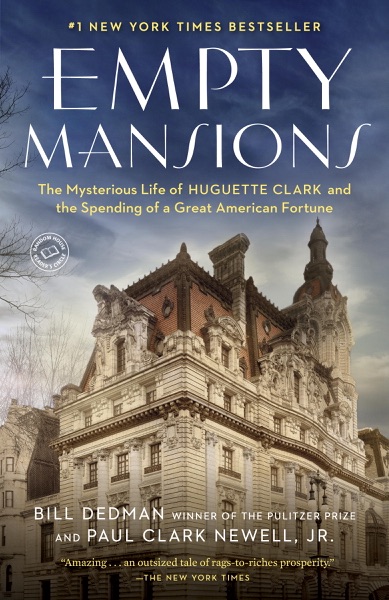
Empty Mansions by Bill Dedman is a 2013 biography book about wealth and isolation, gilded age america, inheritance. Huguette Clark was the daughter of one of Gilded Age America's wealthiest men and outlived him by eight decades, dying in 2011 at 104 while her three properties sat empty and staffed.
Summary
Empty Mansions is the biography of Huguette Clark, an extraordinarily wealthy woman who died in 2011 at the age of 104, having spent the last twenty years of her life in a hospital room she chose not to leave despite being in good health and owning a Santa Barbara estate, a Fifth Avenue apartment, and a Connecticut mansion — all maintained, staffed, and largely unvisited. Pulitzer Prize-winning journalist Bill Dedman and Huguette's cousin Paul Clark Newell Jr. spent years reconstructing her life from court records, private letters, interviews, and the estates themselves.
The story has two threads. One is Huguette herself: born in 1906 to William Andrews Clark, one of the wealthiest men in America (copper magnate, Senator from Montana, art collector), she grew up in an era of Gilded Age extravagance before retreating progressively from public life following the death of her younger sister and, later, her mother. Huguette never had close friends as an adult, never married (her marriage in 1928 lasted nine months), and spent her later decades painting in her apartment, maintaining correspondence with a small number of people, and ordering dollhouses and French chateau models for a collection she rarely showed anyone.
The second thread is the legal drama that followed her death. Huguette left an estate worth hundreds of millions of dollars, and a disputed will divided it between her distant family and her hospital nurse, doctor, and attorney, who had maintained personal relationships with her during her two decades in the hospital. The legal proceedings revealed the details of her last years and raised uncomfortable questions about how isolated wealthy elderly people are protected — or failed to be protected — by those around them.
Dedman writes with the discipline of an investigative reporter, but the book is also genuinely moving. Huguette's story is not really about money — it's about a life shaped by early loss, an extreme temperament, and a kind of voluntary exile from normal human connection. Her three properties were maintained for decades as if she might arrive any day; she never did. The image of those empty mansions, furnished and ready, is the book's governing metaphor.
Talk to Empty Mansions like its author wrote you back.
Get the ideas that fit your life — not generic summaries.
- Chat with the book
- Audiobook-style main ideas
- Adapts to your life and goals
- Helps you take action
Key takeaways
- 1.
Huguette Clark was the daughter of one of Gilded Age America's wealthiest men and outlived him by eight decades, dying in 2011 at 104 while her three properties sat empty and staffed.
- 2.
She chose to spend her last twenty years in a hospital room despite being healthy enough to leave, preferring the contained, controlled world of her room to the larger one outside.
- 3.
William Andrews Clark, Huguette's father, built a copper fortune and became a senator through a combination of business genius and unabashed bribery — one of the Gilded Age's least flattering portraits.
- 4.
Huguette's reclusion intensified after the death of her younger sister in childhood and accelerated after her mother died in 1963. Grief and loss seem to have shaped her choices more than any other factor.
- 5.
The disputed will divided her estate between distant family members she had not seen in decades and the small circle of hospital staff who had become her primary human contact in her final years.
- 6.
The legal case raised serious questions about whether Huguette's final bequests were freely made or the product of undue influence by people who had positioned themselves as her sole connection to the world.
- 7.
Her properties — a Santa Barbara estate, a Fifth Avenue apartment, a Connecticut mansion — were maintained in pristine condition for decades despite being almost entirely unused, at enormous ongoing expense.
- 8.
Dedman's investigative reconstruction relies on court records, correspondence, and interviews to recover the life of someone who deliberately left almost no public record. The biography is partly a detective story.
Discussion questions
Use these on your own, with a book club, or as chat starters in Superbook. Book club version, ready to copy or print →
- 1.
Huguette chose isolation even when she had the resources to live any life she wanted. What does her story suggest about the relationship between wealth and happiness, or between solitude and suffering?
- 2.
Dedman reconstructs her life from documents and interviews with people who knew her. How do you read a biography of someone who worked so hard to avoid being known?
- 3.
The disputed will raises the question of whether Huguette's bequests were freely made. How do you think about undue influence when the person being influenced is isolated, elderly, and has no other close relationships?
- 4.
William Andrews Clark is one of the more disturbing characters in the book — a man who openly bribed his way to a Senate seat and whose philanthropy seemed to coexist comfortably with his methods. What does his story reveal about Gilded Age America?
- 5.
The empty mansions are the book's most striking image — fully staffed properties that their owner almost never visited. What does the maintenance of those empty houses mean to you?
- 6.
Huguette never explained her choices to anyone who wrote them down. What's your interpretation of why she chose the hospital over her homes?
- 7.
The book raises the question of how wealthy, isolated elderly people should be protected from financial exploitation. What would adequate protection look like without being paternalistic?
- 8.
Dedman writes about a world — Fifth Avenue apartments, French dolls, dollhouse collectors — that feels entirely alien to most readers. Did that unfamiliarity affect how you read Huguette's story?
- 9.
Is there something admirable about Huguette's chosen life, or is it purely a portrait of loss and withdrawal? How did you read her as a person?
- 10.
The family members who contested the will had not seen Huguette in decades but were her legal heirs. The hospital staff who received the bequest were her daily companions. Who do you think had the better claim?
- 11.
What does Empty Mansions say about the persistence of class and inherited wealth in American life? Does the story feel dated or recognizable?
Themes
Frequently asked questions
-
What is Empty Mansions about?
It's the biography of Huguette Clark, a copper heiress who died in 2011 at 104 after spending her last twenty years in a hospital by choice, while three fully staffed mansions sat empty. The book covers her family history, her extraordinary reclusion, and the legal battle over her estate after her death.
-
Is Empty Mansions a true crime book?
Not exactly, though it has elements of investigation and a legal drama at its center. It's primarily a biography and social history. The disputed will and questions of elder financial abuse give it some of the texture of true crime, but the tone is more journalistic and sympathetic than sensational.
-
Is Empty Mansions a long read?
It's substantial — around 400 pages — and takes most readers six to eight hours. The book covers a great deal of history (William Clark's Gilded Age career, copper industry history, New York society) in addition to Huguette's personal story. The pacing is leisurely compared to thriller nonfiction.
-
Who should read Empty Mansions?
Readers interested in American Gilded Age history, unusual biography, questions about wealth and isolation, or investigative journalism at its best. Also for anyone who finds extreme human eccentricity fascinating rather than pathological.
-
What happened to Huguette's estate after she died?
After a legal dispute, her estate — valued at around $300 million — was divided between her distant relatives and the people who had cared for her in her final years. The settlement avoided a full trial but left many questions about undue influence unanswered.
Similar books
Educated: A Memoir
Tara Westover
The Glass Castle: A Memoir
Jeannette Walls
The Big Short: Inside the Doomsday Machine
Michael Lewis
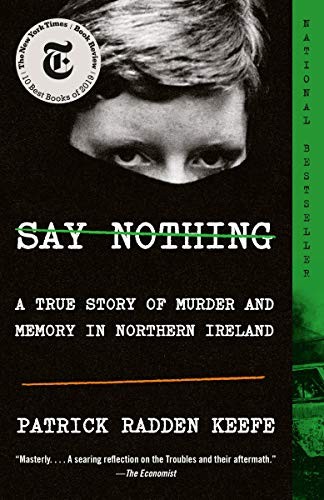
Say Nothing: A True Story of Murder and Memory in Northern Ireland
Patrick Radden Keefe
