Talk to Endure like its author wrote you back.
Get the ideas that fit your life — not generic summaries.
- Chat with the book
- Audiobook-style main ideas
- Adapts to your life and goals
- Helps you take action
Endure, in detail
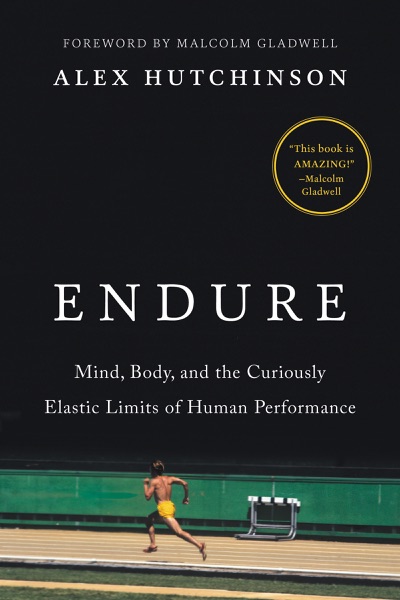
Endure is Alex Hutchinson's investigation into the science of limits — specifically, what actually stops a human being from going faster, farther, or longer. Hutchinson, a science journalist and former competitive runner, structures the book around a deceptively simple question: when you feel like you have nothing left, is that feeling accurate? His answer, drawn from research across exercise physiology, sports science, and neuroscience, is that fatigue is not purely a physical signal from the muscles. It is also, significantly, a prediction and a decision made by the brain.
The central figure is Tim Noakes, the South African exercise physiologist who proposed the Central Governor model — the idea that the brain acts as a regulator, generating sensations of fatigue before the body is actually at its limits, in order to preserve physiological safety margins. The model is controversial, and Hutchinson handles the scientific debate with care, presenting both the evidence for Noakes's framework and the legitimate objections. This is science journalism at its most honest: the conclusion is not a clean resolution but a useful set of tensions.
Hutchinson moves through the specific variables that shape endurance: pain tolerance, self-belief, heat, oxygen deprivation, hydration, nutrition, and the emerging research on brain stimulation and psychological priming. Along the way he profiles athletes who have pushed known limits and researchers who are trying to understand why. The chapter on pacing is particularly useful — most people's intuitions about how to manage effort over a long effort are wrong in predictable ways.
The book is structured around the 2017 Nike Breaking2 project, in which Eliud Kipchoge attempted to break the two-hour marathon barrier. That attempt failed by twenty-five seconds but served as the occasion for Hutchinson's most sustained meditation on what it means to approach a human limit. Endure is not a training guide, but it changes how you think about effort — whether in sport, work, or any domain where the difference between stopping and continuing is partly a matter of what you believe is possible.
The big ideas
- 1.
Fatigue is not a purely physiological signal. The brain generates sensations of exhaustion as a predictive safety mechanism, and those sensations can be recalibrated by belief, pacing strategy, and psychological state.
- 2.
Tim Noakes's Central Governor model challenges the traditional view that muscles simply fail at a fixed threshold. The brain is an active regulator of performance, not just a passive receiver of distress signals.
- 3.
Pain tolerance is trainable, and elite endurance athletes tend to dissociate from pain rather than reduce it — they experience the same sensations but choose to continue anyway.
