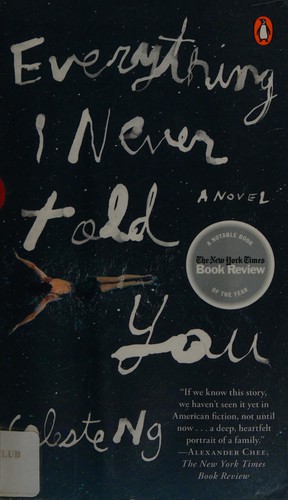
Talk to Everything I Never Told You like its author wrote you back.
Get the ideas that fit your life — not generic summaries.
- Chat with the book
- Audiobook-style main ideas
- Adapts to your life and goals
- Helps you take action
Everything I Never Told You, in detail
Lydia Lee is dead before the first sentence ends. The novel opens with her disappearance and proceeds to dissect, backward and forward, the mixed-race family she leaves behind in 1970s Ohio: her Chinese-American father James, her white mother Marilyn, her overlooked brother Nath, her unseen younger sister Hannah. Ng structures the book as a mystery — how did Lydia die, and why — but the answers are less about criminal acts than about the accumulated weight of what everyone in the family never said.
The novel is about projection. James and Marilyn each had dreams they couldn't fulfill, and each poured those dreams into Lydia without asking whether Lydia wanted to carry them. James, who grew up as the only Asian-American in mostly-white settings, wants Lydia to be socially effortless. Marilyn, who gave up a science career for marriage and motherhood in an era that expected her to, wants Lydia to be the doctor she never became. Lydia is crushed between two fantasies. Ng is precise about how this works: it isn't cruelty, it's love distorted by thwarted need, which is harder to name and harder to resist.
Ng's prose is clean, controlled, and quietly devastating. The 1970s setting gives her space to show the structural forces — on women, on Asian-Americans, on mixed-race families — without lecturing about them. The mystery structure creates forward momentum, but what propels the novel emotionally is the slow revelation of what each family member saw and didn't see about each other. Hannah, the youngest and most invisible, is the most perceptive observer; her sections are some of the best in the book.
This is a debut novel with the assurance of a third. It isn't without flaws — the resolution relies somewhat on revelation rather than transformation — but it's unusually accomplished. Readers drawn to quiet, precise, character-driven domestic tragedy will find this one of the best examples of the form in recent American fiction.
The big ideas
- 1.
Parental love can be a form of appropriation — James and Marilyn don't see Lydia, they see what they need her to be, and the gap kills her.
- 2.
Ng shows that the unseen child (Hannah) often understands the family most clearly. Invisibility, in this novel, is a kind of clarity.
- 3.
The 1970s setting is doing real work: both James's experience of casual racism and Marilyn's experience of institutional sexism are historically grounded, not generic.
