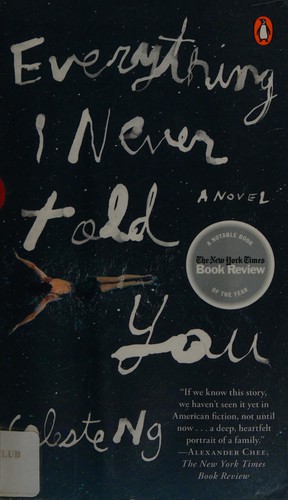
Everything I Never Told You by Celeste Ng is a 2014 literary fiction book about grief and family, race and identity, parental expectations. Parental love can be a form of appropriation — James and Marilyn don't see Lydia, they see what they need her to be, and the gap kills her.
Summary
Lydia Lee is dead before the first sentence ends. The novel opens with her disappearance and proceeds to dissect, backward and forward, the mixed-race family she leaves behind in 1970s Ohio: her Chinese-American father James, her white mother Marilyn, her overlooked brother Nath, her unseen younger sister Hannah. Ng structures the book as a mystery — how did Lydia die, and why — but the answers are less about criminal acts than about the accumulated weight of what everyone in the family never said.
The novel is about projection. James and Marilyn each had dreams they couldn't fulfill, and each poured those dreams into Lydia without asking whether Lydia wanted to carry them. James, who grew up as the only Asian-American in mostly-white settings, wants Lydia to be socially effortless. Marilyn, who gave up a science career for marriage and motherhood in an era that expected her to, wants Lydia to be the doctor she never became. Lydia is crushed between two fantasies. Ng is precise about how this works: it isn't cruelty, it's love distorted by thwarted need, which is harder to name and harder to resist.
Ng's prose is clean, controlled, and quietly devastating. The 1970s setting gives her space to show the structural forces — on women, on Asian-Americans, on mixed-race families — without lecturing about them. The mystery structure creates forward momentum, but what propels the novel emotionally is the slow revelation of what each family member saw and didn't see about each other. Hannah, the youngest and most invisible, is the most perceptive observer; her sections are some of the best in the book.
This is a debut novel with the assurance of a third. It isn't without flaws — the resolution relies somewhat on revelation rather than transformation — but it's unusually accomplished. Readers drawn to quiet, precise, character-driven domestic tragedy will find this one of the best examples of the form in recent American fiction.
Talk to Everything I Never Told You like its author wrote you back.
Get the ideas that fit your life — not generic summaries.
- Chat with the book
- Audiobook-style main ideas
- Adapts to your life and goals
- Helps you take action
Key takeaways
- 1.
Parental love can be a form of appropriation — James and Marilyn don't see Lydia, they see what they need her to be, and the gap kills her.
- 2.
Ng shows that the unseen child (Hannah) often understands the family most clearly. Invisibility, in this novel, is a kind of clarity.
- 3.
The 1970s setting is doing real work: both James's experience of casual racism and Marilyn's experience of institutional sexism are historically grounded, not generic.
- 4.
The novel is structured as a mystery but rewards re-reading as a character study. The 'answer' to Lydia's death changes meaning entirely the second time through.
- 5.
Silence is the novel's central subject. Every important thing in the Lee family goes unsaid, and the unsaid things accumulate until they become fatal.
- 6.
Nath's escape to Harvard is the event that breaks Lydia — not because she loses him, but because it proves escape is possible and she doesn't know how to find it.
- 7.
The novel refuses to villainize James or Marilyn; they are damaged people inflicting damage they don't recognize. That restraint is what makes the book moral rather than moralistic.
- 8.
Everything I Never Told You is partly about what American assimilation demands of Asian-American families: to succeed so visibly at fitting in that the cost becomes invisible.
Discussion questions
Use these on your own, with a book club, or as chat starters in Superbook. Book club version, ready to copy or print →
- 1.
Ng begins with the death and works backward. How does knowing Lydia is dead from the first line change how you read everything that follows?
- 2.
James wants Lydia to be socially easy; Marilyn wants her to be professionally ambitious. Are these projections loving, destructive, or both simultaneously?
- 3.
Nath is the only family member who truly sees Lydia — but he's also leaving. How much does the novel hold him responsible for her death?
- 4.
Hannah is almost invisible to her own family. How does Ng use Hannah's perspective to show what the other characters can't see about themselves?
- 5.
Marilyn's abandonment of her science career is presented as both a personal loss and a structural injustice. Does the novel maintain that distinction, or does one overtake the other?
- 6.
James's fear of standing out, rooted in his experience of being Asian-American in white America, directly shapes his relationship with Lydia. Does the novel treat that fear with sufficient complexity?
- 7.
The Lydia we see in flashback is never quite fully herself — always performing for someone else. Do you think we ever see who she actually was?
- 8.
Marilyn leaves the family for a summer to try to reclaim her dream. How does the novel judge that choice — and how do you?
- 9.
Jack's friendship with Lydia is misread by almost everyone. Does the novel give him enough room to be understood, or is he largely a plot function?
- 10.
The 1970s setting keeps certain structural inequalities in the background rather than the foreground. Would the novel work as well if it were set today?
- 11.
The title — Everything I Never Told You — applies to almost every relationship in the book. Which silences feel most culpable to you, and why?
- 12.
Is the resolution satisfying? The family survives but doesn't transform. Is that an honest ending or an incomplete one?
Themes
Frequently asked questions
-
Is Everything I Never Told You worth reading?
Yes — it's one of the strongest American literary debuts of the 2010s. The characterization is exceptional, the period detail is purposeful, and Ng threads the mystery structure through a genuinely moving family portrait. If you respond to quiet, precise domestic tragedy, this is essential.
-
Is this a mystery novel?
Structurally, yes — it opens with a death and builds toward explaining it. But the 'mystery' is emotional rather than criminal; the question being answered is psychological and familial, not forensic. Readers expecting a thriller will find it slow; readers expecting a literary novel will find the structure serves the story.
-
Is this book hard to read emotionally?
It is painful. The novel is about a family failing a child in ways they can't see, set in an era where certain failures were structurally guaranteed. If that kind of close, accumulating sadness is something you find difficult, pace yourself.
-
Who shouldn't read this book?
Readers who find family drama airless, or who want a plot-driven mystery with a satisfying criminal resolution. The 'answer' to how Lydia died is deliberately anticlimactic — the novel is more interested in the why than the how, and the why is a set of relationships rather than an event.
-
How does this compare to Little Fires Everywhere?
Everything I Never Told You is more intimate and more psychologically intense — smaller in scope, deeper in individual characterization. Little Fires Everywhere is broader, more socially engaged, and better as a book-club novel because it generates more disagreement. This one lingers more.