Short stories · Book club
Exhalation: Stories book club questions
Here are 12 book club questions for Exhalation: Stories by Ted Chiang, ordered to open easily and end somewhere worth arguing about. Copy them, print them, or bring them up one at a time.
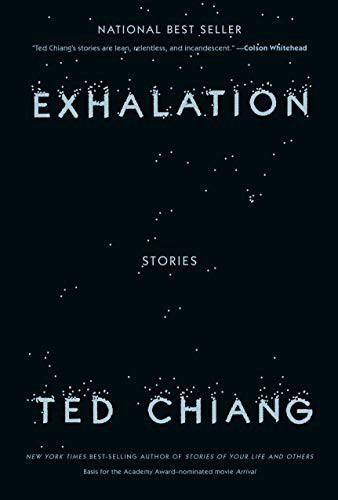
Exhalation: Stories is Ted Chiang's second collection, containing nine stories written between 2005 and 2019.
Ted Chiang · 2019 · 5h 45m
Full summary and key takeaways →The 12 questions
- 1.
'Exhalation' ends with a message to future beings who may inhabit a dead universe: 'Know that there was a universe that was passionate about understanding itself.' Is that a consolation, or does it make the ending sadder?
- 2.
In 'The Lifecycle of Software Objects,' the digients (digital beings) develop apparent personalities and preferences over years of interaction. At what point, if any, do you think they acquired moral status?
- 3.
'Anxiety Is the Dizziness of Freedom' argues that your choices in this branch matter even if another version of you chose differently. Does that argument actually work, or is it a psychological comfort rather than a philosophical one?
- 4.
In 'Omphalos,' a scientist's faith is shattered by the discovery that humans are not the center of creation. She decides to reframe her relationship with God. Is that reframing honest or a cope?
- 5.
Several stories involve characters who choose to accept painful knowledge rather than remain in comfortable ignorance. Is that always the right choice? Does Chiang think so?
- 6.
Chiang's prose is notably clean and impersonal. Does that coldness add to the emotional impact of the stories, or does it keep you at a distance from them?
- 7.
'Dacey's Patent Automatic Nanny' and 'The Great Silence' are the collection's shortest and strangest pieces. What do they add to the collection? Could it exist without them?
- 8.
The premise-to-conclusion rigor that Chiang is known for — following the logic wherever it leads — occasionally produces resolutions that feel more like proofs than endings. Did any story feel like that to you?
- 9.
Compared to his first collection (Stories of Your Life and Others), Exhalation seems less interested in grief and loss and more interested in ethics and free will. Does that feel true reading it? Which concerns resonate more?
- 10.
In 'The Truth of Fact, the Truth of Feeling,' perfect memory technology changes human relationships with the past. Would you want a perfect memory device? What would you lose?
- 11.
Several of Chiang's protagonists are working scientists or engineers. How does that professional background shape the stories' relationship to expertise and certainty?
- 12.
Which story in the collection did you find most challenging — intellectually, emotionally, or both — and why?
How to run the discussion
- Pick six to eight, not all of them. An hour of real discussion covers fewer questions than anyone expects, and racing the list is what makes a book club feel like homework.
- Open with what people noticed, not what they concluded. Asking for a verdict first hardens opinions before anyone has heard each other.
- Let the disagreement run. The questions below that split a room are the ones worth the time; the ones everyone answers the same way can be skipped.
- Ask the quiet person a specific question. A direct, narrow question is far easier to answer than an open invitation to contribute.
Themes worth steering toward
If the conversation stalls, these are the threads that usually restart it.
Common questions
What are good book club questions for Exhalation: Stories?
Here are 12 book club questions for Exhalation: Stories by Ted Chiang, ordered to open easily and end somewhere worth arguing about. The strongest openers ask what each reader noticed rather than what they concluded, and the discussion usually turns on free will and determinism, memory and identity, technology and consciousness.
How long should a book club discussion of Exhalation: Stories last?
Most groups run 60 to 90 minutes of actual discussion. That is roughly six to eight questions, not all of them, so pick the ones that suit your group rather than working down the list in order.
What are the main themes in Exhalation: Stories?
Free will and determinism, Memory and identity, Technology and consciousness, Time and causality, What it means to be human. Those are the threads most likely to divide a room, which makes them the useful places to steer a discussion that has gone quiet.
Picking the next one? See books like Exhalation: Stories or questions for other book club picks.
