Talk to Experiencing Architecture like its author wrote you back.
Get the ideas that fit your life — not generic summaries.
- Chat with the book
- Audiobook-style main ideas
- Adapts to your life and goals
- Helps you take action
What it argues
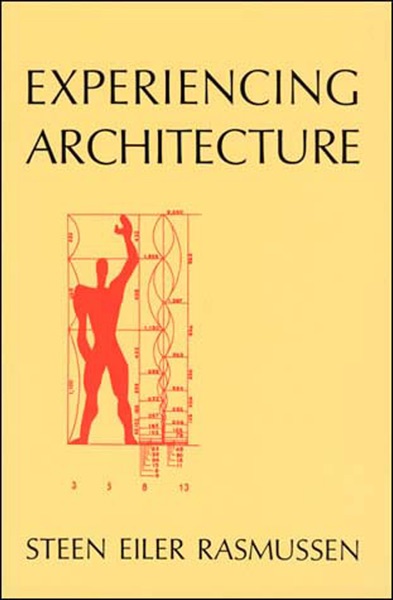
Experiencing Architecture is the Danish architect and town planner Steen Eiler Rasmussen's attempt to teach non-architects how to see and feel buildings. First published in Danish in 1957 and translated into English in 1959, it has been assigned in architecture schools for decades — not primarily as a technical manual, but as an invitation to slow down and notice what built space actually does to the body and the senses.
Rasmussen's argument is that architecture is not primarily a visual art. Most people look at buildings as objects and evaluate their facades, but buildings are experienced from the inside — as sequences of spaces, materials, light, and acoustic environments. The book works through a series of perceptual categories: solid and hollow, rhythm, texture, scale, color, daylight and artificial light, acoustics. In each chapter Rasmussen draws on specific buildings — from English row houses to the Parthenon to Baroque churches — to show how abstract design decisions translate into concrete bodily experience.
What it gets right
- 1.
Architecture is not primarily a visual art. Buildings are experienced as sequences of spaces, materials, light, and sound, not as facades to be admired from outside.
- 2.
Solid and hollow are the fundamental architectural opposition. How a building handles mass versus void, enclosure versus opening, determines how it feels to occupy.
- 3.
Scale is relational, not absolute. A space feels large or small relative to the human body and to adjacent spaces, not according to its measurements.
What it covers
Who wrote it
Steen Eiler Rasmussen (1898–1990) was a Danish architect, urban planner, and writer who spent much of his career at the Royal Danish Academy of Fine Arts. He is known for his work on the planning of Copenhagen and for two books that brought architectural thinking to general audiences: London: The Unique City (1934) and Experiencing Architecture (1957). His writing combined scholarly rigor with genuine accessibility, and Experiencing Architecture in particular became one of the most widely assigned introductions to architectural experience in the English-speaking world.
