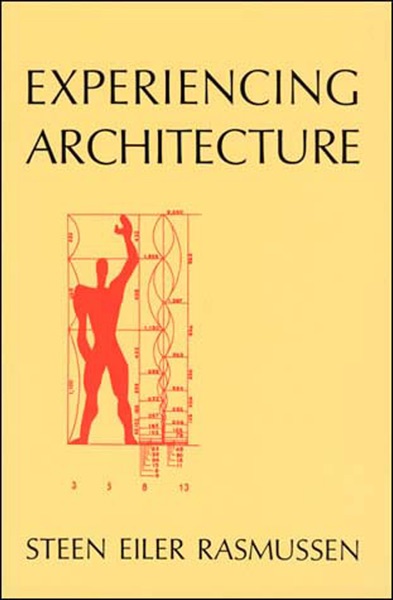
Talk to Experiencing Architecture like its author wrote you back.
Get the ideas that fit your life — not generic summaries.
- Chat with the book
- Audiobook-style main ideas
- Adapts to your life and goals
- Helps you take action
Experiencing Architecture, in detail
Experiencing Architecture is the Danish architect and town planner Steen Eiler Rasmussen's attempt to teach non-architects how to see and feel buildings. First published in Danish in 1957 and translated into English in 1959, it has been assigned in architecture schools for decades — not primarily as a technical manual, but as an invitation to slow down and notice what built space actually does to the body and the senses.
Rasmussen's argument is that architecture is not primarily a visual art. Most people look at buildings as objects and evaluate their facades, but buildings are experienced from the inside — as sequences of spaces, materials, light, and acoustic environments. The book works through a series of perceptual categories: solid and hollow, rhythm, texture, scale, color, daylight and artificial light, acoustics. In each chapter Rasmussen draws on specific buildings — from English row houses to the Parthenon to Baroque churches — to show how abstract design decisions translate into concrete bodily experience.
The acoustic chapter is one of the book's most original contributions. Rasmussen argues that a room has a sound the way it has a color, and that great architecture has historically calibrated acoustic properties to reinforce its character. Gothic cathedrals were built for organ music and plainchant; their long reverb times make speech unintelligible but make sustained tones overwhelming. This reciprocal relationship between form and use is a thread throughout the book: the best buildings are those in which program, structure, material, and sensory experience are so tightly integrated that none of them can be easily separated.
Rasmussen writes in plain, careful prose, and the book is genuinely accessible to readers with no architectural training. It can feel dated in places — it was written during the height of modernism and engages only obliquely with the debates of that moment — but the perceptual framework it offers has not aged. If anything, in an era of screen-mediated architectural experience, Rasmussen's insistence on the primacy of physical presence is more valuable than when he wrote it.
The big ideas
- 1.
Architecture is not primarily a visual art. Buildings are experienced as sequences of spaces, materials, light, and sound, not as facades to be admired from outside.
- 2.
Solid and hollow are the fundamental architectural opposition. How a building handles mass versus void, enclosure versus opening, determines how it feels to occupy.
- 3.
Scale is relational, not absolute. A space feels large or small relative to the human body and to adjacent spaces, not according to its measurements.
