Psychology · Book club
Expert Political Judgment book club questions
Here are 12 book club questions for Expert Political Judgment by Philip Tetlock, ordered to open easily and end somewhere worth arguing about. Copy them, print them, or bring them up one at a time.
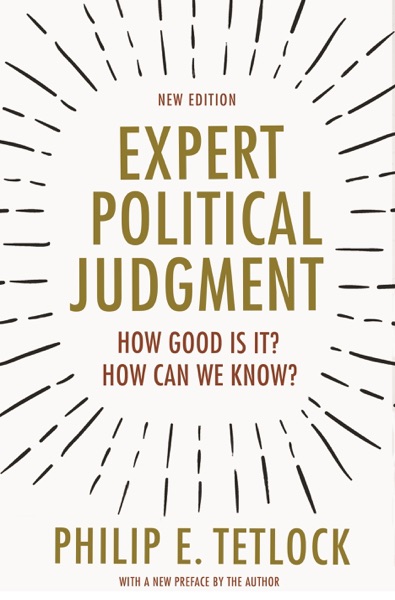
Expert Political Judgment is Philip Tetlock's report on a twenty-year study of political forecasters.
Philip Tetlock · 2005 · 6h 0m
Full summary and key takeaways →The 12 questions
- 1.
Tetlock found that famous, frequently cited experts were no more accurate than less prominent ones. How does that finding change how you read or watch political commentary?
- 2.
The fox-hedgehog distinction cuts across ideology. Can you identify people in your professional life who fit each type, and does the pattern hold — do foxes make better predictions?
- 3.
Tetlock documents how experts use hindsight to reframe failed predictions. Can you recall a specific case — in politics, business, or your own life — where you engaged in this kind of retroactive revision?
- 4.
The book was published in 2005, before social media amplified hedgehog voices further. How has the incentive structure around expert forecasting changed since then?
- 5.
Tetlock argues that epistemic accountability would improve forecasting. What would genuine accountability look like for the pundits or analysts whose work most influences decisions in your field?
- 6.
The fox-hedgehog framework maps onto intellectual styles more broadly. Which type are you, and does the evidence in your own domain support the idea that foxes do better?
- 7.
Tetlock notes that experts are better at explaining why something happened than at predicting what will happen next. What domains in your work exhibit this same asymmetry?
- 8.
The study found that experts with more experience were no more accurate than less experienced ones in most domains. What do you make of that finding for how you evaluate seniority?
- 9.
Calibration requires being able to say 'I'm 60% confident' and mean it. When was the last time you consciously assigned a probability to a professional judgment? Was it accurate?
- 10.
Tetlock's subjects who were most wrong tended to be the most confident. Where in your professional environment is high confidence most valued, and is that a good match for the domain's predictability?
- 11.
The book suggests the media select for hedgehog forecasters because they make better television. Is there an equivalent distortion in how expertise is presented in your industry?
- 12.
What would your organization look like if forecasting accuracy were scored and published — and if promotion depended partly on calibration?
How to run the discussion
- Pick six to eight, not all of them. An hour of real discussion covers fewer questions than anyone expects, and racing the list is what makes a book club feel like homework.
- Open with what people noticed, not what they concluded. Asking for a verdict first hardens opinions before anyone has heard each other.
- Let the disagreement run. The questions below that split a room are the ones worth the time; the ones everyone answers the same way can be skipped.
- Ask the quiet person a specific question. A direct, narrow question is far easier to answer than an open invitation to contribute.
Themes worth steering toward
If the conversation stalls, these are the threads that usually restart it.
Common questions
What are good book club questions for Expert Political Judgment?
Here are 12 book club questions for Expert Political Judgment by Philip Tetlock, ordered to open easily and end somewhere worth arguing about. The strongest openers ask what each reader noticed rather than what they concluded, and the discussion usually turns on forecasting, expertise, political judgment.
How long should a book club discussion of Expert Political Judgment last?
Most groups run 60 to 90 minutes of actual discussion. That is roughly six to eight questions, not all of them, so pick the ones that suit your group rather than working down the list in order.
What are the main themes in Expert Political Judgment?
Forecasting, Expertise, Political judgment, Cognitive bias, Accountability. Those are the threads most likely to divide a room, which makes them the useful places to steer a discussion that has gone quiet.
Picking the next one? See books like Expert Political Judgment or questions for other book club picks.
