Talk to Extraordinary Popular Delusions and the Madness of Crowds like its author wrote you back.
Get the ideas that fit your life — not generic summaries.
- Chat with the book
- Audiobook-style main ideas
- Adapts to your life and goals
- Helps you take action
Extraordinary Popular Delusions and the Madness of Crowds, in detail
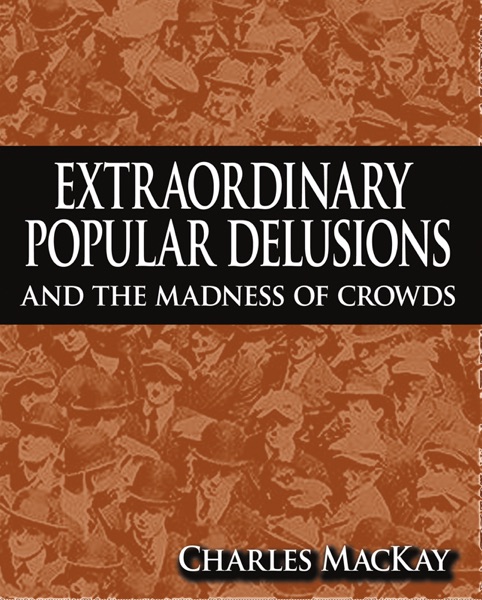
Extraordinary Popular Delusions and the Madness of Crowds, published by Scottish journalist Charles Mackay in 1841, is one of the most quoted books in financial history despite being primarily a work of popular history and entertainment. Mackay documented three major speculative manias — the South Sea Bubble (1720), John Law's Mississippi Company scheme (1719–1720), and the Dutch tulip craze (1636–1637) — along with a sprawling collection of chapters on alchemy, crusades, witch-hunts, fortune-tellers, duels, and other episodes of collective irrationality. The financial chapters are the reason the book is still in print; the rest is Victorian social history of variable quality.
The three financial manias share a common structure that Mackay identified with remarkable clarity nearly two centuries before behavioral finance gave it academic vocabulary. A genuine underlying value or opportunity exists. Speculative interest attracts additional buyers who aren't evaluating fundamentals but following price. Prices rise beyond any rational justification. Credit enables participation by people who can't afford the loss. The mania culminates in a collapse that appears, in retrospect, to have been inevitable all along — and that was, while it was happening, invisible to most participants.
Mackay's argument is simple: crowds are capable of collective irrationality at a scale that individuals rarely match alone. The mechanisms he identifies — social proof, fear of missing out, the credibility lent by the apparent unanimity of others — are precisely what modern behavioral economists study under different names. The tulip mania chapter in particular became foundational for anyone writing about speculative excess, even though some of Mackay's specific claims about tulip pricing have since been disputed by historians.
The book's limitations are substantial and worth acknowledging. The non-financial chapters range from genuinely interesting to tedious, and many readers skip them entirely. Mackay's historical accuracy is inconsistent; he was a journalist with strong opinions, not a meticulous scholar. Some of his accounts have been revised by subsequent research. The writing has a Victorian moralizing quality that can grate. But as the first popular account of how financial manias work, and as a document showing that the pathology was already visible and nameable by the mid-nineteenth century, it earns its place in financial history.
The big ideas
- 1.
Financial manias follow a recurring structure: a real opportunity attracts speculative interest, price rises detach from fundamentals, social proof and credit enable broader participation, and collapse follows.
- 2.
The South Sea Bubble and Mississippi scheme were both enabled by government involvement and explicit official endorsement — state credibility made the mania possible at a scale private schemes alone couldn't achieve.
- 3.
Tulip mania, however exaggerated in later accounts, documented the first recorded commodity futures market crash, where paper contracts for future bulb delivery became as speculative as the underlying commodity.
