Extraordinary Popular Delusions and the Madness of Crowds by Charles Mackay is a 1841 history book about crowd psychology, financial bubbles, mass delusion. Financial manias follow a recurring structure: a real opportunity attracts speculative interest, price rises detach from fundamentals, social proof and credit enable broader participation, and collapse follows.
Summary
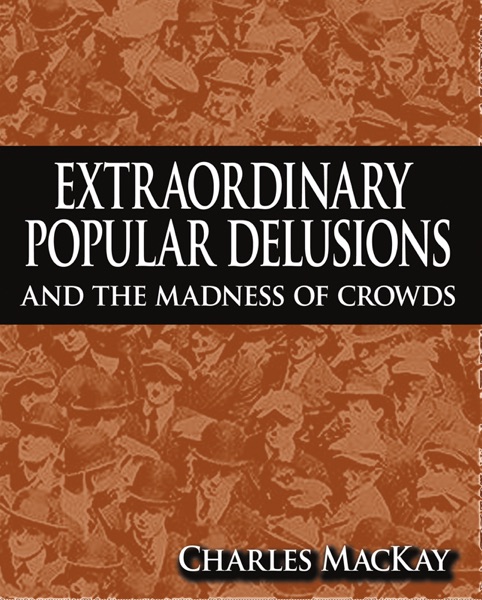
Extraordinary Popular Delusions and the Madness of Crowds, published by Scottish journalist Charles Mackay in 1841, is one of the most quoted books in financial history despite being primarily a work of popular history and entertainment. Mackay documented three major speculative manias — the South Sea Bubble (1720), John Law's Mississippi Company scheme (1719–1720), and the Dutch tulip craze (1636–1637) — along with a sprawling collection of chapters on alchemy, crusades, witch-hunts, fortune-tellers, duels, and other episodes of collective irrationality. The financial chapters are the reason the book is still in print; the rest is Victorian social history of variable quality.
The three financial manias share a common structure that Mackay identified with remarkable clarity nearly two centuries before behavioral finance gave it academic vocabulary. A genuine underlying value or opportunity exists. Speculative interest attracts additional buyers who aren't evaluating fundamentals but following price. Prices rise beyond any rational justification. Credit enables participation by people who can't afford the loss. The mania culminates in a collapse that appears, in retrospect, to have been inevitable all along — and that was, while it was happening, invisible to most participants.
Mackay's argument is simple: crowds are capable of collective irrationality at a scale that individuals rarely match alone. The mechanisms he identifies — social proof, fear of missing out, the credibility lent by the apparent unanimity of others — are precisely what modern behavioral economists study under different names. The tulip mania chapter in particular became foundational for anyone writing about speculative excess, even though some of Mackay's specific claims about tulip pricing have since been disputed by historians.
The book's limitations are substantial and worth acknowledging. The non-financial chapters range from genuinely interesting to tedious, and many readers skip them entirely. Mackay's historical accuracy is inconsistent; he was a journalist with strong opinions, not a meticulous scholar. Some of his accounts have been revised by subsequent research. The writing has a Victorian moralizing quality that can grate. But as the first popular account of how financial manias work, and as a document showing that the pathology was already visible and nameable by the mid-nineteenth century, it earns its place in financial history.
Talk to Extraordinary Popular Delusions and the Madness of Crowds like its author wrote you back.
Get the ideas that fit your life — not generic summaries.
- Chat with the book
- Audiobook-style main ideas
- Adapts to your life and goals
- Helps you take action
Key takeaways
- 1.
Financial manias follow a recurring structure: a real opportunity attracts speculative interest, price rises detach from fundamentals, social proof and credit enable broader participation, and collapse follows.
- 2.
The South Sea Bubble and Mississippi scheme were both enabled by government involvement and explicit official endorsement — state credibility made the mania possible at a scale private schemes alone couldn't achieve.
- 3.
Tulip mania, however exaggerated in later accounts, documented the first recorded commodity futures market crash, where paper contracts for future bulb delivery became as speculative as the underlying commodity.
- 4.
Social proof is central to speculative manias: when everyone around you is getting rich, the psychological cost of skepticism becomes enormous. The rational minority gets worn down.
- 5.
Mackay wrote in 1841 and already had three clear examples of the same pattern. The fact that major financial bubbles have continued to occur at regular intervals since then is itself a lesson in the limits of historical knowledge.
- 6.
The people inside a mania rarely lack intelligence or information about historical precedents. They construct reasons to believe their situation is different.
- 7.
The collapse phase of a mania often involves the same social dynamics as the expansion phase: once selling begins, social proof operates in reverse, and rational buyers stay away until prices have fallen further than they should.
- 8.
The non-financial sections of the book — witch-hunts, alchemy, the crusades — are Mackay's argument that financial manias are one instance of a broader human tendency toward collective unreason that appears in religion, politics, and social life.
Discussion questions
Use these on your own, with a book club, or as chat starters in Superbook. Book club version, ready to copy or print →
- 1.
Mackay wrote about three financial manias and implied the pattern was clearly recognizable. Why do you think the same pattern recurs in financial markets despite widespread awareness of the history?
- 2.
Which elements of the tulip mania, South Sea Bubble, or Mississippi scheme do you see reflected in financial markets or technologies today?
- 3.
Mackay published in 1841. What does the continued relevance of a 180-year-old book suggest about whether human behavior in crowds changes?
- 4.
The book argues that intelligent people are not protected from manias. What makes collective irrationality so hard to resist even when you recognize it?
- 5.
How do you distinguish between a genuine new opportunity that early participants are right to value highly and a mania that will collapse?
- 6.
The financial chapters are considered much more valuable than the rest of the book. What does that suggest about why certain historical examples stick in a culture's memory and others don't?
- 7.
Mackay has been criticized for inaccuracy on some specific historical claims. Does that reduce the value of the book's core argument, or is the argument separable from the historical details?
- 8.
The Mississippi scheme required government participation to reach the scale it did. What contemporary analogies to that dynamic — speculative assets endorsed or enabled by government action — can you identify?
- 9.
What psychological conditions are necessary for a mania to get started? Which of those conditions are currently present in any market you're watching?
- 10.
Mackay assumes individual irrationality is largely tamed by solitude and group irrationality is the problem. Do you think that's right, or does individual irrationality feed into collective manias in ways he underweights?
- 11.
If a close friend told you they were heavily invested in something that had the structural features of a mania, what would you say?
Themes
Frequently asked questions
-
Do I need to read the whole book, or just the financial chapters?
The three financial chapters — South Sea Bubble, Mississippi scheme, and tulip mania — are the reason most people read the book and are entirely self-contained. The remaining chapters on alchemy, witch-hunts, and similar topics are interesting Victorian social history but not essential for readers primarily interested in market psychology.
-
How long does it take to read Extraordinary Popular Delusions?
The full book is very long — well over 700 pages in most editions — and takes 14 to 15 hours to read completely. The three financial chapters alone take two to three hours. Most investors read selectively rather than cover to cover.
-
Is Mackay's history accurate?
Mixed. The broad narrative of each mania is accurate, but some specific claims — particularly about tulip pricing — have been challenged by later historians. The book is more reliable as psychological observation than as detailed historical record.
-
Why is this book still relevant nearly 200 years after publication?
Because the pattern it documents — speculative mania driven by social proof, credit, and detachment from fundamentals — has recurred repeatedly since 1841. The book gives readers a vocabulary and historical grounding for recognizing the pattern in real time.
-
What's the most important lesson for a modern investor?
That the feeling of certainty during a mania is itself a warning sign. Mackay's participants were not stupid; they had reasons for their beliefs and found support for them everywhere they looked. Recognizing that dynamic doesn't make you immune, but it should make you more cautious when the social environment makes skepticism feel socially costly.