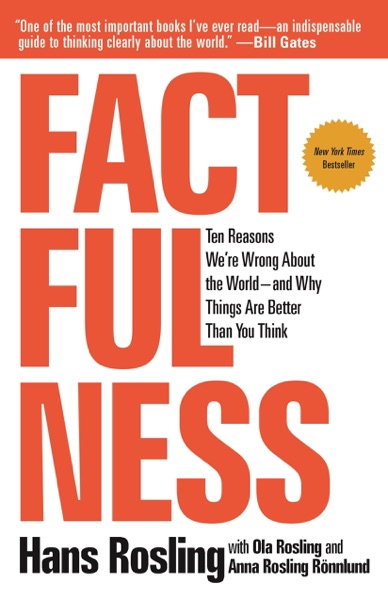
Talk to Factfulness: Ten Reasons We're Wrong About the World like its author wrote you back.
Get the ideas that fit your life — not generic summaries.
- Chat with the book
- Audiobook-style main ideas
- Adapts to your life and goals
- Helps you take action
Factfulness: Ten Reasons We're Wrong About the World, in detail
Hans Rosling spent decades testing audiences of students, professors, journalists, and politicians on basic facts about global development — child mortality rates, literacy, extreme poverty, life expectancy — and found consistently that even well-educated, well-intentioned people performed worse than chance. Not just ignorant but systematically wrong, in the direction of pessimism: more likely to believe the world is worse than it is than to believe it is better. Factfulness, which Rosling finished from his deathbed and which his son Ola and daughter-in-law Anna completed after his death, is his account of why this is and what to do about it.
The ten instincts Rosling identifies are cognitive patterns that warp perception of data: the gap instinct (seeing the world as divided into two groups rather than a spectrum), the negativity instinct (remembering bad news more than good), the straight-line instinct (projecting linear trends into the future), the fear instinct (overweighting vivid dangers), the size instinct (failing to compare numbers), the generalization instinct (using stereotypes for groups), and several others. Each chapter pairs a description of the instinct with the factual data it distorts and a practical rule for resisting it.
The statistical case is strong and clearly presented. Global extreme poverty has fallen from around 85% in 1800 to under 10% today. Child mortality, maternal mortality, and deaths from infectious disease have all fallen dramatically. Access to electricity, schooling, and clean water has expanded. Rosling argues these improvements are real, important, and systematically underperceived — and that the misperception has consequences, leading to poor policy priorities and cynicism about whether development assistance works.
The book's limitations are methodological and political. Rosling's four-level income framework simplifies a complex picture, and his focus on trends in aggregate averages can obscure persistent inequality and recent setbacks. He is also somewhat dismissive of structural critiques of development — questions about colonialism, resource extraction, and the terms of global trade — in a way that some readers find inadequate. The optimism is evidence-based but is not the same as a comprehensive account of development.
The big ideas
- 1.
Most people systematically underestimate global progress on health, education, and poverty — and the more educated they are, the more confidently they hold these wrong beliefs.
- 2.
The world is not divided into 'developed' and 'developing' countries; there is a continuous spectrum of income levels, and most people now live in the middle.
- 3.
Extreme poverty has fallen from 85% of humanity in 1800 to under 10% today — one of the most remarkable improvements in human welfare in history.
