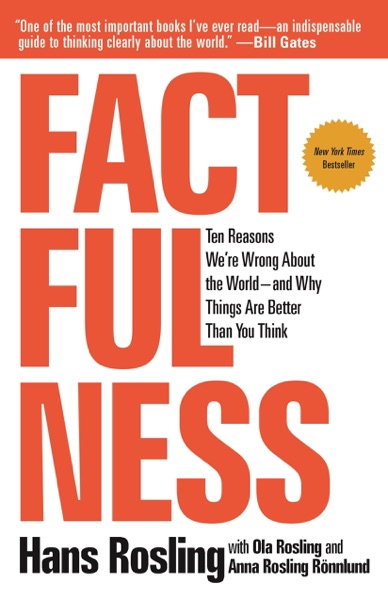
Factfulness: Ten Reasons We're Wrong About the World by Hans Rosling is a 2018 economics book about human progress, global development, statistical literacy. Most people systematically underestimate global progress on health, education, and poverty — and the more educated they are, the more confidently they hold these wrong beliefs.
Summary
Hans Rosling spent decades testing audiences of students, professors, journalists, and politicians on basic facts about global development — child mortality rates, literacy, extreme poverty, life expectancy — and found consistently that even well-educated, well-intentioned people performed worse than chance. Not just ignorant but systematically wrong, in the direction of pessimism: more likely to believe the world is worse than it is than to believe it is better. Factfulness, which Rosling finished from his deathbed and which his son Ola and daughter-in-law Anna completed after his death, is his account of why this is and what to do about it.
The ten instincts Rosling identifies are cognitive patterns that warp perception of data: the gap instinct (seeing the world as divided into two groups rather than a spectrum), the negativity instinct (remembering bad news more than good), the straight-line instinct (projecting linear trends into the future), the fear instinct (overweighting vivid dangers), the size instinct (failing to compare numbers), the generalization instinct (using stereotypes for groups), and several others. Each chapter pairs a description of the instinct with the factual data it distorts and a practical rule for resisting it.
The statistical case is strong and clearly presented. Global extreme poverty has fallen from around 85% in 1800 to under 10% today. Child mortality, maternal mortality, and deaths from infectious disease have all fallen dramatically. Access to electricity, schooling, and clean water has expanded. Rosling argues these improvements are real, important, and systematically underperceived — and that the misperception has consequences, leading to poor policy priorities and cynicism about whether development assistance works.
The book's limitations are methodological and political. Rosling's four-level income framework simplifies a complex picture, and his focus on trends in aggregate averages can obscure persistent inequality and recent setbacks. He is also somewhat dismissive of structural critiques of development — questions about colonialism, resource extraction, and the terms of global trade — in a way that some readers find inadequate. The optimism is evidence-based but is not the same as a comprehensive account of development.
Talk to Factfulness: Ten Reasons We're Wrong About the World like its author wrote you back.
Get the ideas that fit your life — not generic summaries.
- Chat with the book
- Audiobook-style main ideas
- Adapts to your life and goals
- Helps you take action
Key takeaways
- 1.
Most people systematically underestimate global progress on health, education, and poverty — and the more educated they are, the more confidently they hold these wrong beliefs.
- 2.
The world is not divided into 'developed' and 'developing' countries; there is a continuous spectrum of income levels, and most people now live in the middle.
- 3.
Extreme poverty has fallen from 85% of humanity in 1800 to under 10% today — one of the most remarkable improvements in human welfare in history.
- 4.
The negativity instinct leads us to remember and weight bad news more than good news, which is evolutionarily sensible but statistically distorting.
- 5.
The gap instinct makes us see separation between groups that are in fact on a continuum; the 'developing world' is not one thing but a distribution across billions of people.
- 6.
The fear instinct causes us to overestimate risks from dramatic, vivid events — terrorism, plane crashes — and underestimate risks from slow, unglamorous killers.
- 7.
The straight-line instinct assumes trends will continue linearly; population growth, for example, will level off as child survival improves, as it has historically.
- 8.
Factfulness is a discipline, not a mood: it means forming opinions from data, not from intuition, and updating those opinions when data changes.
Discussion questions
Use these on your own, with a book club, or as chat starters in Superbook. Book club version, ready to copy or print →
- 1.
Rosling argues most educated people believe the world is worse than it is. Did you find that true of yourself when you checked your own assumptions?
- 2.
The four income levels framework is designed to replace 'developed/developing.' How useful did you find that replacement, and what does it still leave out?
- 3.
Which of the ten instincts do you think most distorts how you personally perceive global events? Can you give a recent example?
- 4.
Rosling attributes the negativity instinct partly to news media. How do you calibrate your information diet given that compelling stories and genuine progress are both real?
- 5.
The book focuses on long-run trends. How does that framing affect how we should think about recent setbacks — COVID deaths, rising inequality, climate disruption?
- 6.
Rosling is deliberately optimistic about development as a corrective to misperception. Does that stance risk its own form of selective emphasis?
- 7.
How does Factfulness engage with structural critiques of development — colonialism, debt, trade terms? Is that engagement adequate?
- 8.
Child mortality rates have fallen dramatically. What factors does Rosling attribute this to, and how convincing do you find the attribution?
- 9.
The book was finished posthumously by Rosling's family. Does knowing that affect how you read it?
- 10.
Rosling argues that good data should change how we prioritize aid and policy. Which priorities would shift if decision-makers fully absorbed his framework?
- 11.
The generalization instinct chapter argues we rely on stereotypes about regions and groups. Where did you notice yourself doing this while reading the book?
- 12.
Rosling distinguishes between factfulness and optimism: one is about evidence, the other is about mood. Is that distinction practical in real decision-making?
Themes
Frequently asked questions
-
What is Factfulness about?
Rosling argues that humans are systematically wrong about global development — more pessimistic than the data warrants — because of ten cognitive instincts that distort perception. The book documents those instincts, presents the actual data on global progress, and offers practical rules for thinking more accurately.
-
Is Factfulness worth reading?
Yes. Its empirical case for global progress is well-documented and the cognitive framework is genuinely useful. Readers should supplement it with perspectives on distributional inequality and structural development critique, which the book handles lightly.
-
How long does it take to read Factfulness?
About five hours at average pace. The chapters are organized around the ten instincts and are relatively self-contained. The writing is conversational and moves quickly.
-
Who should read Factfulness?
Everyone, but particularly journalists, educators, policy professionals, and anyone whose work requires accurate mental models of global conditions. Also strongly recommended for anyone who follows global news and wants to calibrate how representative their information diet is.
-
What is the most useful idea in Factfulness?
The discipline of always asking: what is this number compared to? The size instinct leads us to treat all large numbers as comparably alarming. Placing numbers in proportion — per capita, as a fraction, as a trend — is Rosling's most teachable practical tool.
Similar books
Enlightenment Now
Steven Pinker
The Rational Optimist: How Prosperity Evolves
Matt Ridley
Sapiens: A Brief History of Humankind
Yuval Noah Harari
Thinking, Fast and Slow
Daniel Kahneman
