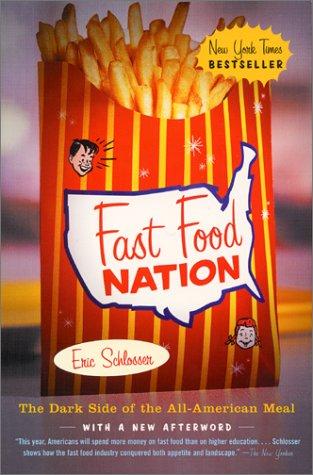
Talk to Fast Food Nation like its author wrote you back.
Get the ideas that fit your life — not generic summaries.
- Chat with the book
- Audiobook-style main ideas
- Adapts to your life and goals
- Helps you take action
What it argues
Eric Schlosser's Fast Food Nation is one of the most consequential pieces of American investigative journalism of the early twenty-first century. Published in 2001, it traced the fast food industry from its origins in mid-century Southern California drive-ins through its expansion into a global system that shapes American agriculture, labor markets, diets, and culture in ways most consumers don't see. Schlosser's argument is not simply that fast food is unhealthy but that the industry's scale and business model have fundamentally restructured American life, mostly to the benefit of corporations and at the expense of workers, small farmers, and public health.
The book moves through a series of interconnected investigations. Schlosser profiles Colorado Springs, a city shaped by both the military and fast food chains, as a case study in what the industry does to a community. He embeds in the meatpacking industry — the hidden back end of the hamburger supply chain — and documents working conditions in slaughterhouses that rival the worst industrial abuses of the early twentieth century: extraordinarily high injury rates, deliberate understaffing of safety positions, systematic suppression of union organizing, and a workforce composed largely of recent immigrants with limited options. The chapter on meatpacking is the most disturbing in the book and the one most critics cite as its strongest.
What it gets right
- 1.
The fast food industry shaped American agriculture, culture, and labor markets as much as it was shaped by them, transforming entire sectors of the economy around its supply chain needs.
- 2.
Meatpacking, the industrial back end of the hamburger, is one of the most dangerous occupations in the United States, with injury rates far higher than official statistics capture.
- 3.
Fast food chains systematically target children through marketing, creating brand loyalty before children have the cognitive tools to evaluate commercial messages.
What it covers
Who wrote it
Eric Schlosser is an American journalist and author whose work focuses on the hidden infrastructure of American industries. In addition to Fast Food Nation, he co-authored Chew on This, a version of the book aimed at younger readers, and wrote Reefer Madness, an investigation into underground economies in the United States. He has written for The Atlantic, Rolling Stone, and The New Yorker, and produced the film adaptation of Fast Food Nation as well as the documentary Food, Inc. He continues to write about labor, food, and criminal justice.
