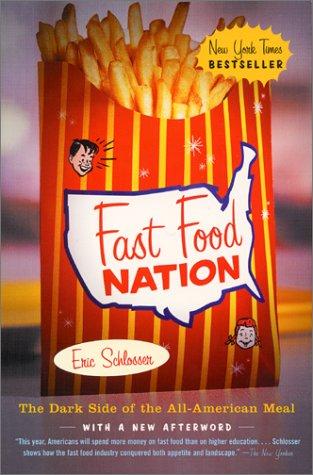
Fast Food Nation by Eric Schlosser is a 2001 science book about food industry, labor, corporate power. The fast food industry shaped American agriculture, culture, and labor markets as much as it was shaped by them, transforming entire sectors of the economy around its supply chain needs.
Summary
Eric Schlosser's Fast Food Nation is one of the most consequential pieces of American investigative journalism of the early twenty-first century. Published in 2001, it traced the fast food industry from its origins in mid-century Southern California drive-ins through its expansion into a global system that shapes American agriculture, labor markets, diets, and culture in ways most consumers don't see. Schlosser's argument is not simply that fast food is unhealthy but that the industry's scale and business model have fundamentally restructured American life, mostly to the benefit of corporations and at the expense of workers, small farmers, and public health.
The book moves through a series of interconnected investigations. Schlosser profiles Colorado Springs, a city shaped by both the military and fast food chains, as a case study in what the industry does to a community. He embeds in the meatpacking industry — the hidden back end of the hamburger supply chain — and documents working conditions in slaughterhouses that rival the worst industrial abuses of the early twentieth century: extraordinarily high injury rates, deliberate understaffing of safety positions, systematic suppression of union organizing, and a workforce composed largely of recent immigrants with limited options. The chapter on meatpacking is the most disturbing in the book and the one most critics cite as its strongest.
Schlosser also investigates the flavor industry, which produces the artificial and natural flavorings that make processed food taste the way it does, and the marketing industry that targets children. The chapter on flavor is unexpectedly fascinating — a visit to a New Jersey flavor compound reveals that almost nothing in processed food tastes like the ingredient it claims to represent, and that the line between "natural" and "artificial" flavors is far less meaningful than labeling suggests.
Fast Food Nation is investigative rather than prescriptive. Schlosser draws conclusions and makes his concerns clear, but his goal is to document a system rather than to provide dietary advice. Two decades after publication, many of the specific conditions he described have worsened in scale, and the competitive pressures he identified as the source of labor and safety failures continue to shape the industry. The book remains a foundational text for understanding how the American food system works and who it works for.
Talk to Fast Food Nation like its author wrote you back.
Get the ideas that fit your life — not generic summaries.
- Chat with the book
- Audiobook-style main ideas
- Adapts to your life and goals
- Helps you take action
Key takeaways
- 1.
The fast food industry shaped American agriculture, culture, and labor markets as much as it was shaped by them, transforming entire sectors of the economy around its supply chain needs.
- 2.
Meatpacking, the industrial back end of the hamburger, is one of the most dangerous occupations in the United States, with injury rates far higher than official statistics capture.
- 3.
Fast food chains systematically target children through marketing, creating brand loyalty before children have the cognitive tools to evaluate commercial messages.
- 4.
The flavor industry produces the tastes in most processed foods through chemical compounds that have little connection to the ingredients named on the label.
- 5.
The consolidation of meat processing into a small number of very large companies reduced prices but eliminated the labor protections and wages that earlier generations of meatpacking workers had built.
- 6.
Franchise systems transfer financial risk to individual franchise owners while keeping the brand, menu, and supply chain control firmly with the corporation.
- 7.
The expansion of fast food globally exports not just food but a model of cheap labor, standardized supply chains, and aggressive youth marketing.
- 8.
The political power of the food industry — its lobbying, its influence on regulatory agencies, and its campaign contributions — explains much of the gap between public health evidence and food policy.
Discussion questions
Use these on your own, with a book club, or as chat starters in Superbook. Book club version, ready to copy or print →
- 1.
Schlosser frames fast food as a system, not just a product. Does thinking about it as a system change how you relate to it personally?
- 2.
The meatpacking chapter describes working conditions that most consumers never think about. Does knowing the conditions change what you're willing to buy or eat?
- 3.
How much responsibility does a fast food company bear for the health outcomes of customers who freely choose its products?
- 4.
Schlosser argues that children cannot meaningfully consent to commercial persuasion. Should food marketing to children be more heavily regulated?
- 5.
The flavor industry chapter reveals that 'natural flavor' is nearly meaningless on a label. Does that change how you read food packaging?
- 6.
Fast food companies argue they give consumers what consumers want. Schlosser argues companies shaped what consumers want. Who's right, and does the distinction matter?
- 7.
The franchise model transfers risk to franchisees while keeping control centralized. What does that tell you about how corporate risk is managed in the food industry?
- 8.
Schlosser published in 2001. How much do you think has changed in the fast food industry since then, and how much is structurally the same?
- 9.
Meatpacking jobs are disproportionately held by recent immigrants with limited options. What is the relationship between labor vulnerability and food system safety?
- 10.
Do you think individual purchasing decisions can meaningfully change a system as large as the fast food industry, or does change require policy?
- 11.
Fast Food Nation is often described as a book that changed readers' eating habits. Did it or would it change yours? What's the mechanism if so?
- 12.
Schlosser is a journalist rather than a scientist or policy expert. How does the investigative journalism form — with sources, visits, documents — shape how you evaluate his claims?
Themes
Frequently asked questions
-
Is Fast Food Nation still relevant today?
Yes. The structural conditions Schlosser documented — meatpacking consolidation, youth marketing, franchise risk transfer, regulatory capture — remain substantially in place. Some specific details have shifted, but the book's argument about how the system works holds. It's better read as a systemic analysis than a current news report.
-
How long is Fast Food Nation?
About 350 pages of text plus extensive endnotes, roughly six to seven hours of reading time. The chapters are self-contained enough to read selectively, though the full impact comes from the cumulative argument.
-
Is Fast Food Nation a polemic?
Schlosser has a clear point of view, but the book's substance is investigative reporting backed by documents, industry data, and on-site visits. It reads closer to journalism than advocacy, though the conclusions he draws are pointed.
-
What is the most disturbing part of the book?
For most readers, the meatpacking chapter. The injury rates, the deliberate suppression of workers' compensation claims, and the conditions in industrialized slaughterhouses are documented with unusual specificity.
-
Who should read Fast Food Nation?
Anyone interested in how the American food system operates and who it serves. Also recommended for readers interested in labor, corporate power, or the relationship between industry and government regulation.