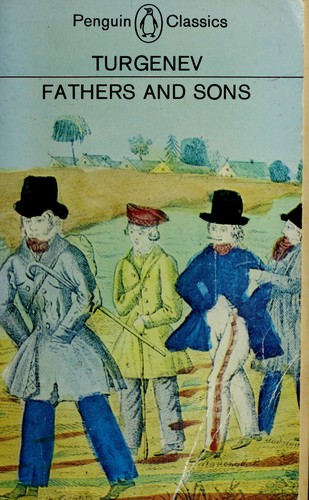
Talk to Fathers and Sons like its author wrote you back.
Get the ideas that fit your life — not generic summaries.
- Chat with the book
- Audiobook-style main ideas
- Adapts to your life and goals
- Helps you take action
What it argues
Fathers and Sons opens with a young medical student, Bazarov, arriving at a country estate alongside his friend Arkady. Bazarov is a self-proclaimed nihilist — he believes in nothing that cannot be dissected, tested, or verified. He has no patience for art, sentiment, or the liberal convictions of Arkady's father and uncle. The novel is set in the early 1860s, just as Russia is beginning to question the old aristocratic order, and Bazarov is its sharpest, most uncompromising critic.
What the book is actually about is the failure of total systems — the impossibility of living a purely rational, emotion-free existence. Turgenev puts Bazarov's nihilism under pressure by giving him the one thing his philosophy can't accommodate: he falls in love. The collision between Bazarov's intellectual certainty and his own feelings is the novel's emotional center, and Turgenev handles it with unusual restraint. He never mocks Bazarov, but he doesn't spare him either.
What it gets right
- 1.
Bazarov's nihilism is presented as genuinely coherent — not a pose, but a worked-out worldview — which makes its limitations more interesting than a simple refutation would be.
- 2.
The generational conflict in the novel isn't simply old vs. young. Turgenev shows that each generation carries blind spots the other can see clearly, and that neither side wins.
- 3.
Love is the one force Turgenev allows to genuinely destabilize Bazarov's system — not argument or evidence, but an involuntary feeling he can neither analyze nor escape.
What it covers
Who wrote it
Ivan Turgenev (1818–1883) was a Russian novelist, short story writer, and playwright, best known for Fathers and Sons, his hunting sketches A Sportsman's Notebook, and the novels Rudin and On the Eve. He was among the first Russian writers to gain wide recognition in Western Europe, and his clear, economical prose influenced later writers including Henry James. He spent much of his adult life in Paris and Baden-Baden, remaining at a critical distance from the reforms and revolutions that transformed Russia. He was a committed opponent of serfdom.
