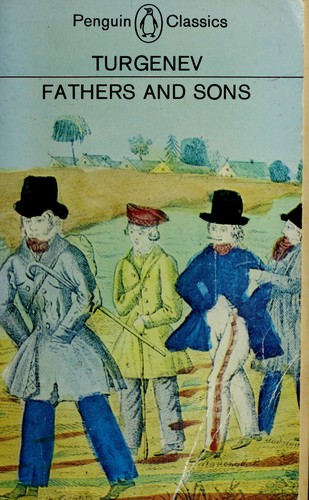
Talk to Fathers and Sons like its author wrote you back.
Get the ideas that fit your life — not generic summaries.
- Chat with the book
- Audiobook-style main ideas
- Adapts to your life and goals
- Helps you take action
Fathers and Sons, in detail
Fathers and Sons opens with a young medical student, Bazarov, arriving at a country estate alongside his friend Arkady. Bazarov is a self-proclaimed nihilist — he believes in nothing that cannot be dissected, tested, or verified. He has no patience for art, sentiment, or the liberal convictions of Arkady's father and uncle. The novel is set in the early 1860s, just as Russia is beginning to question the old aristocratic order, and Bazarov is its sharpest, most uncompromising critic.
What the book is actually about is the failure of total systems — the impossibility of living a purely rational, emotion-free existence. Turgenev puts Bazarov's nihilism under pressure by giving him the one thing his philosophy can't accommodate: he falls in love. The collision between Bazarov's intellectual certainty and his own feelings is the novel's emotional center, and Turgenev handles it with unusual restraint. He never mocks Bazarov, but he doesn't spare him either.
The writing is remarkably spare for nineteenth-century Russian fiction — no Tolstoyan digressions, no Dostoevskian hysteria. Turgenev's dialogue crackles. His characters argue about ideas in ways that feel contemporary. The novel scandalized Russian readers in 1862: radicals thought Bazarov was a caricature, conservatives thought he was glorified. That simultaneous offense from both sides is usually the sign of something true.
Readers who want extended interior monologue or dense plotting will be unsatisfied. This is a slim, controlled novel that makes its case through scenes rather than argument. It rewards rereading. The ending is devastating in a way that only becomes clear after you've put the book down and thought about what Turgenev chose not to give his protagonist.
The big ideas
- 1.
Bazarov's nihilism is presented as genuinely coherent — not a pose, but a worked-out worldview — which makes its limitations more interesting than a simple refutation would be.
- 2.
The generational conflict in the novel isn't simply old vs. young. Turgenev shows that each generation carries blind spots the other can see clearly, and that neither side wins.
- 3.
Love is the one force Turgenev allows to genuinely destabilize Bazarov's system — not argument or evidence, but an involuntary feeling he can neither analyze nor escape.
