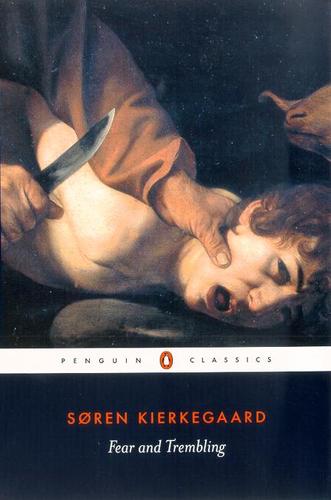
Talk to Fear and Trembling like its author wrote you back.
Get the ideas that fit your life — not generic summaries.
- Chat with the book
- Audiobook-style main ideas
- Adapts to your life and goals
- Helps you take action
Fear and Trembling, in detail
Fear and Trembling was published in 1843 under the pseudonym Johannes de Silentio, and it is Kierkegaard's most sustained meditation on the nature of faith through the lens of the story of Abraham and Isaac. God commands Abraham to sacrifice his only son — the son who was himself the fulfillment of God's promise of progeny as numerous as the stars. How can Abraham act on this command? What kind of consciousness makes it possible to obey? These are the questions the book relentlessly examines.
Kierkegaard identifies three stages of existence: the aesthetic (living for pleasure and immediate gratification), the ethical (living according to universal moral principles), and the religious (a relationship to God that can supersede the ethical). The knight of infinite resignation — who makes the sacrifice, surrenders the finite, and receives nothing back — is admirable but remains on the far side of faith. The knight of faith — like Abraham — makes the same sacrifice and then, against all reason and ethical justification, expects by virtue of the absurd to receive the finite back. This is not the consolation of guaranteed reward but the completely inexplicable confidence that the impossible is possible.
The "teleological suspension of the ethical" is the book's central philosophical concept: Abraham's act cannot be justified by any universal ethical principle. If he follows God's command, he is a murderer by any standard ethics can offer. The only justification is the absolute relationship to the absolute — his direct, singular, unjustifiable relationship with God. This is what makes faith, on Kierkegaard's account, so much harder than resignation: resignation achieves peace by giving up, faith achieves peace by holding on against all rational justification.
Fear and Trembling is a polemical text written against Hegel's rationalization of religion — his absorption of religious faith into the ethical and rational. Kierkegaard insists that genuine faith is a scandal to ethics, not its completion. The book has been enormously influential on existentialist theology, 20th-century philosophy of religion, and the philosophical analysis of moral dilemmas. It is also one of the most elegantly written works in the entire philosophical tradition.
The big ideas
- 1.
Faith is not a preliminary stage to genuine knowledge or ethics but a higher stage that can supersede the ethical through direct relationship to God.
- 2.
The teleological suspension of the ethical: Abraham's act cannot be justified by any universal moral principle — its only ground is his absolute relationship to the absolute.
- 3.
The knight of infinite resignation gives up the finite and achieves peace through renunciation; the knight of faith gives up the finite and expects by virtue of the absurd to receive it back.
