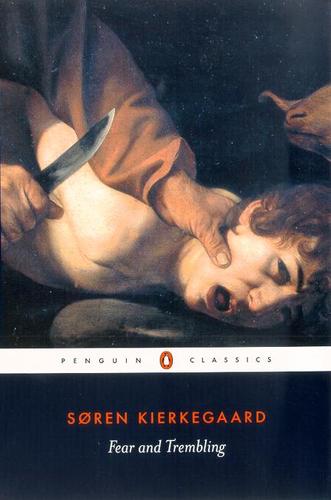
Fear and Trembling by Søren Kierkegaard is a 1843 philosophy book about faith, anxiety, sacrifice. Faith is not a preliminary stage to genuine knowledge or ethics but a higher stage that can supersede the ethical through direct relationship to God.
Summary
Fear and Trembling was published in 1843 under the pseudonym Johannes de Silentio, and it is Kierkegaard's most sustained meditation on the nature of faith through the lens of the story of Abraham and Isaac. God commands Abraham to sacrifice his only son — the son who was himself the fulfillment of God's promise of progeny as numerous as the stars. How can Abraham act on this command? What kind of consciousness makes it possible to obey? These are the questions the book relentlessly examines.
Kierkegaard identifies three stages of existence: the aesthetic (living for pleasure and immediate gratification), the ethical (living according to universal moral principles), and the religious (a relationship to God that can supersede the ethical). The knight of infinite resignation — who makes the sacrifice, surrenders the finite, and receives nothing back — is admirable but remains on the far side of faith. The knight of faith — like Abraham — makes the same sacrifice and then, against all reason and ethical justification, expects by virtue of the absurd to receive the finite back. This is not the consolation of guaranteed reward but the completely inexplicable confidence that the impossible is possible.
The "teleological suspension of the ethical" is the book's central philosophical concept: Abraham's act cannot be justified by any universal ethical principle. If he follows God's command, he is a murderer by any standard ethics can offer. The only justification is the absolute relationship to the absolute — his direct, singular, unjustifiable relationship with God. This is what makes faith, on Kierkegaard's account, so much harder than resignation: resignation achieves peace by giving up, faith achieves peace by holding on against all rational justification.
Fear and Trembling is a polemical text written against Hegel's rationalization of religion — his absorption of religious faith into the ethical and rational. Kierkegaard insists that genuine faith is a scandal to ethics, not its completion. The book has been enormously influential on existentialist theology, 20th-century philosophy of religion, and the philosophical analysis of moral dilemmas. It is also one of the most elegantly written works in the entire philosophical tradition.
Talk to Fear and Trembling like its author wrote you back.
Get the ideas that fit your life — not generic summaries.
- Chat with the book
- Audiobook-style main ideas
- Adapts to your life and goals
- Helps you take action
Key takeaways
- 1.
Faith is not a preliminary stage to genuine knowledge or ethics but a higher stage that can supersede the ethical through direct relationship to God.
- 2.
The teleological suspension of the ethical: Abraham's act cannot be justified by any universal moral principle — its only ground is his absolute relationship to the absolute.
- 3.
The knight of infinite resignation gives up the finite and achieves peace through renunciation; the knight of faith gives up the finite and expects by virtue of the absurd to receive it back.
- 4.
The individual stands before God in a relationship that cannot be mediated by any community, institution, or universal principle.
- 5.
Genuine faith is a scandal to ethics, not its refinement: the father who would kill his son is either a murderer or a man of faith, and nothing in between.
- 6.
Anxiety is the dizziness of freedom — the awareness of the vertigo at the edge of every genuine choice — and is inseparable from genuine existence.
- 7.
Three movements are required for faith: infinite resignation, the experience of the void, and then the leap back to the finite by virtue of the absurd.
- 8.
Kierkegaard insists that faith cannot be communicated, only witnessed: the moment it is explained it ceases to be the thing he is pointing at.
Discussion questions
Use these on your own, with a book club, or as chat starters in Superbook. Book club version, ready to copy or print →
- 1.
Kierkegaard presents Abraham as a hero of faith rather than a would-be murderer. Is that reading of the story compelling to you, or does it require too much from the concept of faith?
- 2.
The teleological suspension of the ethical means a higher duty can override ordinary moral obligations. Is that a dangerous principle or a necessary one?
- 3.
The knight of faith looks completely ordinary from the outside — he walks, eats, enjoys the world — but inside has made the double movement. Is that portrayal convincing?
- 4.
Kierkegaard says faith is a scandal to reason and ethics. Have you ever had a commitment or conviction that you could not rationally justify but that felt like the most authentic thing about you?
- 5.
The three stages — aesthetic, ethical, religious — form a hierarchy. Where do you see yourself in that framework, and does the hierarchy seem accurate?
- 6.
Fear and Trembling is written under a pseudonym (Johannes de Silentio) who claims not to understand faith but only to admire it from outside. Why might Kierkegaard have made that choice?
- 7.
The book argues that the individual's direct relationship to God is unmediated by community or institution. Is that individualism a feature of genuine faith or a distinctly modern distortion of religion?
- 8.
Kierkegaard wrote against Hegel's rationalization of religion. What do you think is at stake in that debate — does genuine religious faith require irrationality?
- 9.
The concept of the absurd here is different from Camus' — for Kierkegaard it is the ground of faith; for Camus it is the ground of revolt. What is the crucial difference?
- 10.
Abraham acts in absolute silence — he cannot explain himself to Sarah, to Isaac, or to anyone. What does that silence tell you about the kind of faith Kierkegaard is describing?
- 11.
If the teleological suspension of the ethical is a real possibility, how do you distinguish genuine faith from fanaticism or delusion?
Themes
Frequently asked questions
-
What is Fear and Trembling about?
An extended meditation on the story of Abraham and Isaac — God's command to Abraham to sacrifice his son — as a vehicle for analyzing the nature of genuine faith, its relationship to ethics, and what it means to stand as an individual before the absolute.
-
What is the teleological suspension of the ethical?
The claim that a higher obligation — Abraham's absolute duty to God — can suspend universal ethical norms. Murder is wrong by any ethical standard, but Abraham's act is not murder, Kierkegaard argues, because it is performed within an absolute relationship to the absolute that transcends ethical categories.
-
What is the knight of faith?
Someone who has made the infinite movement of resignation — given up all claim to the finite — and then, by virtue of the absurd, makes the equally difficult movement back to expect the finite. Abraham is the paradigm: he gave Isaac up and then expected to receive him back.
-
Who is Johannes de Silentio?
Kierkegaard's pseudonymous author for Fear and Trembling — 'John of the Silence.' The persona is significant: he presents himself as someone who cannot make the movement of faith but can describe it from outside with admiration. This creates ironic distance between the author and the argument.
-
Is this book religious or philosophical?
Both, inseparably. It uses the Abraham story to make a philosophical argument about the limits of ethics, the nature of individual existence, and the structure of genuine faith. Secular readers engage with it as philosophy; religious readers engage with it as theology. Both are legitimate.