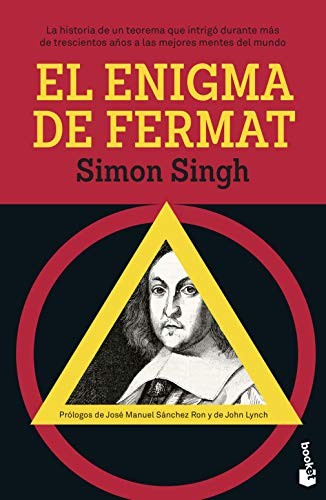
Fermat's Enigma by Simon Singh is a 1997 science book about mathematics, obsession, history of science. Fermat's Last Theorem states that a^n + b^n = c^n has no integer solutions when n is greater than 2. Fermat claimed a proof; no proof was found for 358 years.
Summary
In 1637, Pierre de Fermat scrawled a note in the margin of a mathematics book claiming to have found a proof that no three positive integers can satisfy the equation a^n + b^n = c^n for any integer value of n greater than 2 — but that the margin was too narrow to contain it. That marginal note became the most famous unsolved problem in the history of mathematics, and it remained unsolved for 358 years. Simon Singh tells the story of how it was finally resolved in 1994, when Princeton mathematician Andrew Wiles completed a seven-year secret project to produce a proof spanning more than 100 pages.
The book works on two levels simultaneously. On one level it is intellectual history: Singh traces three and a half centuries of mathematicians who devoted their careers to the problem, from Euler and Gauss to Kummer, Mordell, and finally Wiles. He explains the mathematics with rare clarity — elliptic curves, modular forms, the Taniyama-Shimura conjecture, and the Galois representations that Wiles used to bridge them — in ways that a reader with no formal mathematics training can follow. On another level it is a human drama: Wiles spent seven years working in secret, avoiding conferences and declining to mention his work for fear of competition, and his announcement in June 1993 — followed by the discovery of a flaw, the 14 months of despair, and finally the fix — is one of the great scientific narratives of the 20th century.
Singh is a physicist and documentarian who made a BBC documentary about Wiles before writing this book, and the access he had to Wiles gives the account an intimacy unusual for a mathematics book. Wiles describing the moment he found the fix — "it was so indescribably beautiful" — carries weight that a more distant narrative wouldn't achieve.
The book does more than tell one story. It uses Fermat's Last Theorem as a lens through which to explain number theory more broadly, making the case that the pursuit of pure mathematical knowledge has intrinsic value independent of any application. The proof of Fermat's Last Theorem has no known practical use. Singh argues implicitly, and Wiles argues explicitly, that this is irrelevant. The problem was beautiful and it mattered.
Talk to Fermat's Enigma like its author wrote you back.
Get the ideas that fit your life — not generic summaries.
- Chat with the book
- Audiobook-style main ideas
- Adapts to your life and goals
- Helps you take action
Key takeaways
- 1.
Fermat's Last Theorem states that a^n + b^n = c^n has no integer solutions when n is greater than 2. Fermat claimed a proof; no proof was found for 358 years.
- 2.
Andrew Wiles's proof works by establishing the Taniyama-Shimura conjecture for semistable elliptic curves, which had been shown to imply Fermat's Last Theorem by Ribet in 1986.
- 3.
Elliptic curves and modular forms are two apparently unrelated areas of mathematics that Taniyama and Shimura conjectured were secretly the same objects — a bridge between two mathematical worlds.
- 4.
The proof was announced in June 1993, found to contain a flaw, and then fixed in September 1994 — a period of near-collapse that Wiles has described as the most emotionally difficult year of his life.
- 5.
Throughout the history of the problem, failed attempts to prove Fermat's theorem produced significant mathematics: Kummer's work on ideal numbers, which he developed while trying to prove a special case, had major independent value.
- 6.
Pure mathematics — pursued for its own sake, without regard to application — repeatedly produces results that turn out to be essential for physics and engineering decades later.
- 7.
The secrecy Wiles maintained for seven years was unusual and enabled his success: it prevented him being scooped and gave him space to work without peer scrutiny on a problem that might look unpromising from outside.
- 8.
Singh argues that mathematical proof is the highest standard of certainty any intellectual enterprise achieves — that once proven, mathematical results are simply true, without qualification.
Discussion questions
Use these on your own, with a book club, or as chat starters in Superbook. Book club version, ready to copy or print →
- 1.
Wiles spent seven years in secret on a single problem. What does that level of obsession look like from the inside, and what does it say about how transformative work gets done?
- 2.
Singh describes mathematics as the pursuit of certain knowledge. How does that compare to how certainty works in other fields you know — science, law, history?
- 3.
Kummer's failed proof produced important mathematics anyway. What does that suggest about how we should evaluate intellectual work that doesn't reach its stated goal?
- 4.
Wiles had childhood memories of being fascinated by Fermat's problem. How much does early exposure to an unsolved problem shape the questions we spend our careers on?
- 5.
The proof of Fermat's Last Theorem has no known practical use. Is that a problem? How do you think about pure research versus applied research in terms of social value?
- 6.
Singh describes the mathematical community's reaction to Wiles's announcement: excitement, admiration, and then the discovery of the flaw. How do you think scientific communities should handle announced results before they're verified?
- 7.
The Taniyama-Shimura conjecture linked two apparently unrelated areas of mathematics. Is there an equivalent moment in another field you know where two unrelated things turned out to be secretly the same?
- 8.
What does it mean to say a mathematical proof is beautiful? Is that aesthetic judgment reliable, or is it just what hard ideas feel like when they finally click?
- 9.
Wiles worked alone. Much modern science involves large collaborative teams. What does each approach enable that the other can't?
- 10.
Singh says mathematical certainty is different from empirical certainty. Do you agree? What would it take to be as certain about a historical claim as a mathematical one?
- 11.
How did Singh's storytelling change how you relate to a field — mathematics — that can feel cold or abstract?
- 12.
Fermat probably didn't have a valid proof. What do you make of the marginal note that started everything — mistake, teasing, or something else?
Themes
Frequently asked questions
-
Is Fermat's Enigma accessible to readers without a math background?
Yes. Singh explains every mathematical concept from first principles and uses diagrams and analogies throughout. Some later chapters on elliptic curves and modular forms are dense, but readers can follow the human story without fully absorbing the technical details. The math is present and honest, not watered down — but it is never impenetrable.
-
How long does it take to read Fermat's Enigma?
Around five to six hours. The narrative momentum accelerates significantly as the book approaches 1993 and Wiles's announcement. Many readers report finishing the final third in a single sitting.
-
What is Fermat's Last Theorem?
The claim that the equation a^n + b^n = c^n has no solution in positive integers when n is greater than 2. It's a generalization of the Pythagorean theorem. Fermat claimed to have a proof; no one verified one until Andrew Wiles in 1994.
-
Is this the same story as the 1996 BBC documentary?
The book and documentary were developed together and cover the same subject. The book is substantially longer and goes deeper into the mathematical history. Wiles's interview footage in the documentary is memorable, and many readers find watching the documentary after reading the book rewarding.
-
Who should read Fermat's Enigma?
Anyone who enjoys intellectual biography and the history of ideas. The book works even for readers who find mathematics daunting, because the central subject — one man's obsession with a 350-year-old problem — is fundamentally human.
Similar books
A Beautiful Mind
Sylvia Nasar

The Man Who Knew Infinity
Robert Kanigel
Genius: The Life and Science of Richard Feynman
James Gleick
Code: The Hidden Language of Computer Hardware and Software
Charles Petzold
