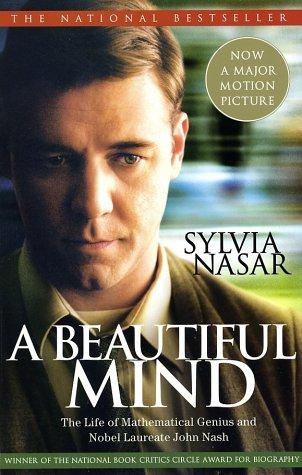
A Beautiful Mind by Sylvia Nasar is a 1998 biography book about genius, mental illness, mathematics. Mathematical genius and social dysfunction can coexist not just incidentally but structurally. Nash's most significant work was produced during a period of extreme personal difficulty.
Summary
Sylvia Nasar's biography of the mathematician John Nash — Nobel laureate, game theory pioneer, and paranoid schizophrenic — is one of the finest accounts of genius and mental illness in biographical literature. Published in 1998, it traces Nash's improbable trajectory from a brilliant and arrogant graduate student at Princeton in the late 1940s to three decades of psychosis, institutionalization, and social invisibility, and finally to a late-life emergence, recovery, and the Nobel Prize in Economics in 1994.
The early chapters establish Nash's mathematical gifts and his personality's more troubling dimensions. He was visibly contemptuous of colleagues, careless of other people's feelings, and sexually unconventional in ways that generated considerable institutional anxiety in 1950s America. His contributions to mathematics — the Nash equilibrium in game theory, his work on manifolds and partial differential equations — were made in a concentrated burst of about five years and were of sufficient depth that other mathematicians are still unpacking them. Nasar explains the mathematics accessibly without condescending; she is genuinely interested in the ideas, not just the biography.
The breakdown chapters are the most challenging to read. Nash began experiencing symptoms of paranoid schizophrenia in his late twenties — delusions about coded messages in newspapers, a conviction that he was receiving communications from extraterrestrial beings, beliefs about conspiracies that were organized and detailed and entirely disconnected from reality. Nasar traces the decades of hospitalization, electroconvulsive therapy, medication, periods of remission and relapse, and the patient loyalty of Nash's wife Alicia, who divorced him, eventually took him back, and cared for him through the worst years.
The recovery is the biography's most unusual section because it does not conform to standard narrative of treatment and cure. Nash's remission appears to have been largely self-directed — a decision, in his late forties, to begin rejecting the delusional thoughts and to rebuild rational thinking voluntarily. Whether this is accurate self-reporting or a post-hoc rationalization is a question Nasar considers seriously. The Nobel Prize in 1994 was itself a kind of collective judgment that the mathematical work had mattered independently of the life that surrounded it.
Talk to A Beautiful Mind like its author wrote you back.
Get the ideas that fit your life — not generic summaries.
- Chat with the book
- Audiobook-style main ideas
- Adapts to your life and goals
- Helps you take action
Key takeaways
- 1.
Mathematical genius and social dysfunction can coexist not just incidentally but structurally. Nash's most significant work was produced during a period of extreme personal difficulty.
- 2.
Paranoid schizophrenia does not erase the person inside it. Nash remained recognizably himself — arrogant, curious, unconventional — even during the worst periods of his illness.
- 3.
Alicia Nash's loyalty is one of the biography's most complex moral subjects. Her decision to stand by Nash was neither simple selflessness nor simple codependency.
- 4.
The Nobel committee's choice to award Nash in 1994 required a judgment that his illness did not invalidate his mathematical contributions. That judgment was contested.
- 5.
Game theory as intellectual revolution: the Nash equilibrium changed economics, evolutionary biology, political science, and military strategy. The biography provides the best accessible explanation of why.
- 6.
Nasar's research required reconstructing a man who had been largely silent for thirty years. The sources — colleagues, former patients, his son, Alicia — give partial and sometimes conflicting pictures.
- 7.
Recovery from major psychiatric illness, in Nash's account, involved a kind of volitional discipline — choosing not to engage with delusional thoughts — that psychiatry does not fully explain.
- 8.
Princeton as a specific intellectual ecology: the Institute for Advanced Study and the mathematics department in the postwar years were simultaneously brilliant and brutal, and Nash thrived and suffered in both senses.
Discussion questions
Use these on your own, with a book club, or as chat starters in Superbook. Book club version, ready to copy or print →
- 1.
Nash's recovery seems to have been partly self-directed. Do you find that account plausible, or does it seem like a comforting story that papers over more mundane pharmaceutical and institutional factors?
- 2.
Alicia Nash stayed with John through decades of illness, divorce, and return. How do you evaluate her choices — as devotion, self-sacrifice, or something more complicated?
- 3.
The biography describes Nash's arrogance and his carelessness about other people's feelings in some detail. Does this humanize him, or does it make him less sympathetic?
- 4.
Nash made his most important contributions in five years of concentrated work before his breakdown. What does that concentrated productivity suggest about the conditions under which great mathematical work happens?
- 5.
The Nobel committee passed over Nash for years partly because of his illness. What should the criteria be for scientific prizes when the prizewinner has been incapacitated for decades?
- 6.
Nasar reconstructs Nash's inner life during psychosis partly from his own later accounts. How reliable is that kind of retrospective self-report?
- 7.
Game theory is now applied across many fields. The biography precedes some of its most important applications. Does knowing about those later developments change how you read the account of Nash's original work?
- 8.
The film adaptation won four Oscars and is much better known than the book. How does the film's representation of Nash's illness — more dramatic and visually spectacular than Nasar's — change the story?
- 9.
What does the biography suggest about the relationship between mathematical gift and personality disorder? Is there a connection, or is it coincidence?
- 10.
Nash lived until 2015 and was killed in a car accident returning from the Abel Prize ceremony in Norway. Does knowing how his story ended change how you read the biography?
- 11.
Nasar is primarily an economics journalist, not a mathematician. Does her outsider perspective help or hinder the account of the mathematical work?
Themes
Frequently asked questions
-
Is A Beautiful Mind accurate?
The book is meticulously researched and Nasar is transparent about uncertainty. Some details disputed after publication included aspects of Nash's sexuality and specific characterizations of his behavior at Princeton. Nash himself endorsed the book broadly. The film departs significantly from the biography.
-
How does the book differ from the film?
The film omits Nash's homosexual relationships entirely, condenses the timeline, and dramatizes the psychosis differently. The book's account of Alicia Nash is more complex and the recovery less miraculous. The biography is significantly richer and more ambivalent than the film.
-
Do I need to understand game theory to read A Beautiful Mind?
No. Nasar explains the Nash equilibrium and Nash's other contributions clearly and accessibly. The mathematical sections are the best lay explanations of the work available.
-
What is the Nash equilibrium?
A concept in game theory describing a stable state in which no player can benefit by changing their strategy while other players keep theirs unchanged. It became foundational in economics, evolutionary biology, and political science, providing a mathematical framework for analyzing competitive interactions.
-
Is this primarily a biography or a book about mathematics?
Both. Nasar is genuinely interested in the mathematics and explains it with more care than most science biographers. But the book's emotional core is Nash's illness, recovery, and the people around him. Readers come for either subject and find the other rewarding.