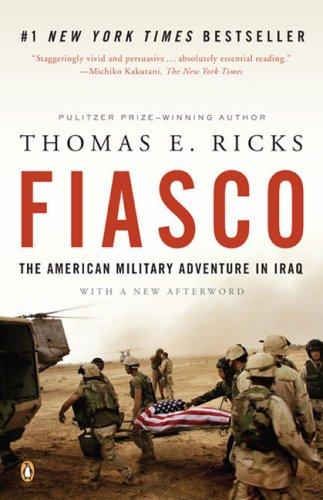
Talk to Fiasco: The American Military Adventure in Iraq like its author wrote you back.
Get the ideas that fit your life — not generic summaries.
- Chat with the book
- Audiobook-style main ideas
- Adapts to your life and goals
- Helps you take action
Fiasco: The American Military Adventure in Iraq, in detail
Thomas Ricks was the Pentagon correspondent for the Washington Post when he wrote Fiasco, and the book reflects years of direct access to the military officials, planners, and soldiers involved in the Iraq War. Published in 2006, while the war was still ongoing, it was immediately controversial: its central argument is that the Iraq invasion and occupation were not merely unfortunate but the product of specific, identifiable failures of planning, strategy, and leadership that could have been avoided.
Ricks traces the disaster from its roots in the neoconservative ambition to remake the Middle East, through the intelligence manipulations that built the case for invasion, to the occupation decisions that transformed a military victory into a political catastrophe. He argues that the decision to invade was made with minimal serious analysis of what would follow — that senior military and civilian leadership simply assumed the post-Saddam political vacuum would fill itself. The disbanding of the Iraqi army by L. Paul Bremer in May 2003, against the advice of most military commanders on the ground, appears in the book as a defining moment: it created a large, armed, unemployed population with every reason to join an insurgency.
The book's second half covers the early occupation and the emergence of the insurgency in exhaustive detail. Ricks draws on after-action reports, military documents, and extensive interviews to show a pattern of tactical competence combined with strategic incoherence. American units that performed their immediate missions well — clearing a town, killing insurgent cells — often left behind conditions that regenerated opposition. The failure to understand the political dynamics of Iraqi society, particularly the sectarian tensions between Sunni and Shia, was systematic rather than accidental.
Ricks takes care to distinguish between the institution of the Army and specific leaders who failed it. Some commanders understood the situation clearly and adapted; others did not. The book identifies both. For anyone trying to understand how the most powerful military in history managed to bog itself down in a protracted insurgency it had neither planned for nor understood, Fiasco remains the essential account.
The big ideas
- 1.
The decision to invade Iraq was made without serious planning for the post-Saddam political vacuum. Senior leadership assumed the situation would manage itself.
- 2.
Disbanding the Iraqi army in May 2003 was the single most consequential occupation decision. It created hundreds of thousands of armed, unemployed men with grievances and organizational experience.
- 3.
The intelligence used to build the public case for invasion was shaped to support a predetermined conclusion. The dissents within the intelligence community were suppressed rather than adjudicated.
