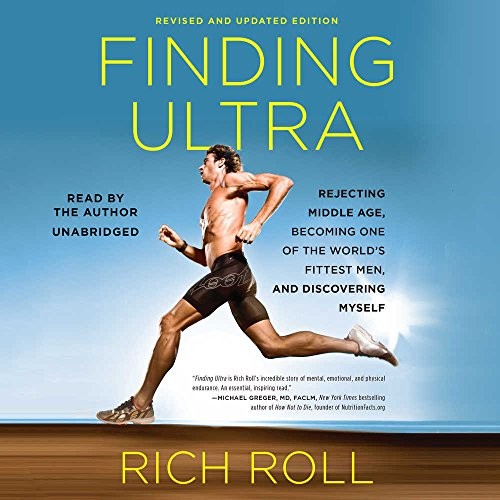
Talk to Finding Ultra like its author wrote you back.
Get the ideas that fit your life — not generic summaries.
- Chat with the book
- Audiobook-style main ideas
- Adapts to your life and goals
- Helps you take action
What it argues
Finding Ultra is Rich Roll's memoir of going from overweight, alcoholic attorney at age forty to competing in the Ultraman World Championship — a three-day, 320-mile endurance race — on a fully plant-based diet. The arc is classic redemption narrative, but Roll's account has enough specificity and self-awareness to avoid the genre's predictability. He does not arrive at transformation through a single revelation but through a slow accumulation of decisions, each requiring the previous one.
Roll's background is swimming: he was a nationally ranked collegiate swimmer at Stanford before alcohol derailed his career and, eventually, his life. The memoir opens with him fat and winded at age forty, climbing a staircase and stopping halfway. This is the catalyst. He starts running and cycling, eventually competes in triathlons, and then — in a pattern familiar to people with addictive temperaments who find a healthy substitute — he escalates to the most extreme events he can find.
What it gets right
- 1.
Recovery from addiction sometimes finds a healthy expression in extreme physical challenges — the same temperament that produces addiction can be redirected into endurance training.
- 2.
Athletic potential at forty is not exhausted: Roll completed his first Ironman triathlon with months of training after a decade of sedentary, unhealthy living.
- 3.
A whole-food, plant-based diet supported extreme endurance performance without protein deficiency — Roll's experience challenges the assumption that animal protein is required for athletic recovery.
What it covers
Who wrote it
Rich Roll is an American ultraendurance athlete, podcaster, author, and public speaker. He attended Stanford University on a swimming scholarship and later earned a law degree from Cornell Law School, where he practiced entertainment and sports law. After his transformation at age forty, he was named one of the twenty-five fittest men in the world by Men's Fitness magazine. His Finding Ultra podcast has millions of listeners and features conversations with athletes, scientists, and thinkers on health and performance. He is also the author of The Plantpower Way (with Julie Piatt) and other works on plant-based athletics.
