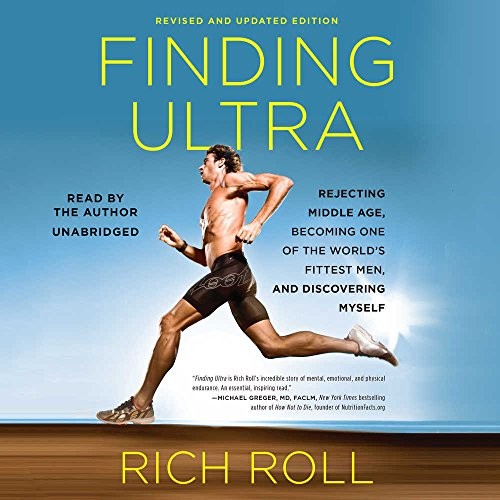
Talk to Finding Ultra like its author wrote you back.
Get the ideas that fit your life — not generic summaries.
- Chat with the book
- Audiobook-style main ideas
- Adapts to your life and goals
- Helps you take action
Finding Ultra, in detail
Finding Ultra is Rich Roll's memoir of going from overweight, alcoholic attorney at age forty to competing in the Ultraman World Championship — a three-day, 320-mile endurance race — on a fully plant-based diet. The arc is classic redemption narrative, but Roll's account has enough specificity and self-awareness to avoid the genre's predictability. He does not arrive at transformation through a single revelation but through a slow accumulation of decisions, each requiring the previous one.
Roll's background is swimming: he was a nationally ranked collegiate swimmer at Stanford before alcohol derailed his career and, eventually, his life. The memoir opens with him fat and winded at age forty, climbing a staircase and stopping halfway. This is the catalyst. He starts running and cycling, eventually competes in triathlons, and then — in a pattern familiar to people with addictive temperaments who find a healthy substitute — he escalates to the most extreme events he can find.
The plant-based dimension is central to the book's argument. Roll transitioned to a whole-food, plant-based diet, eliminating all animal products, and attributes much of his athletic transformation to it. He partners with his wife Julie Piatt, a vegan chef, whose influence on the dietary experiment is documented throughout. Roll acknowledges he cannot know with certainty how much his results were caused by the plant-based diet versus training, sobriety, or motivation, but the experiment produced enough results to make him a convert.
The Ultraman race account in the final section is the book's most gripping writing — five days in Hawaii, extreme distances, mechanical failures, and the physical limit of what a middle-aged body can do. Roll's account of finding his edge is genuine rather than performed, and the descriptions of training — the loneliness of long training hours, the negotiation between discipline and obsession — are more honest than most athletic memoirs. The book is as much about recovery from addiction and the search for a life with meaning as it is about endurance sport, and it works better as the former than as a dietary prescription.
The big ideas
- 1.
Recovery from addiction sometimes finds a healthy expression in extreme physical challenges — the same temperament that produces addiction can be redirected into endurance training.
- 2.
Athletic potential at forty is not exhausted: Roll completed his first Ironman triathlon with months of training after a decade of sedentary, unhealthy living.
- 3.
A whole-food, plant-based diet supported extreme endurance performance without protein deficiency — Roll's experience challenges the assumption that animal protein is required for athletic recovery.
